


Thanks to the kind offices of Niall Macdonald, great-grand son of the late Neil Angus of that ilk, I have been loaned copies of two interesting, early piping books.
I always enjoy a browse through this material. It lets us see how the music, and the writing of it, has developed, and it shows how the early scribes endeavoured to put an oral tradition down on paper.
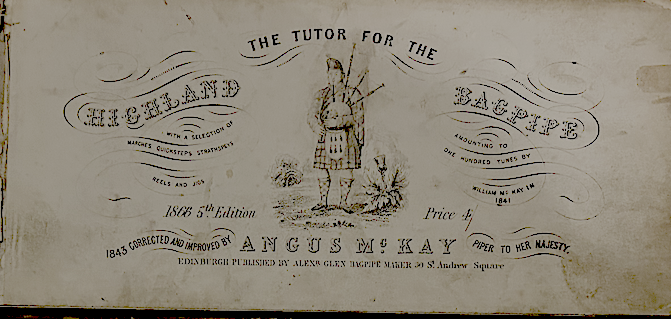
The first is David Glen’s ‘Tutor for the Highland Bagpipe’, 1866, a fifth edition, which was ‘corrected and improved’ by Angus MacKay no less in 1841.
By the Editor
There are a scant four pages of instruction and then 100 tunes. How anyone would learn from such a book is hard to see, but clearly it was intended as an adjunct to personal, master to pupil, tuition.
The first tune is ‘Titi Taiti’ [sic] which we know as Scots Wha’ Hae, after R Burns, and its subtitle is given as ‘King Robt. Bruce’s March’:
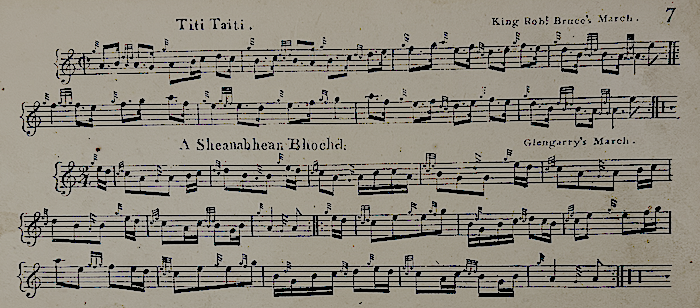
Incidentally the same tune was used by J Percy Sturrock in his ‘Tutor for Boys’ written for the Boys Brigade in 1909, and by Seumas MacNeill and Tommy Pearston in their College of Piping tutor of 1953.
Glen’s Tutor offers advice which all teachers and pupils should adhere to: each new movement must thoroughly mastered before moving on to the next. ‘Improvement is more likely to be retarded by haste than by deliberation’, it says.
The book states that the thumb of the bottom hand should be placed precisely behind the C finger. Well I prefer it a little higher, between D & C, but it should certainly never be below the C. I have seen pipers, some leading players, who have this thumb as far down as behind the B hole. This can cause a contortion of the hand and problems when trying to make B gracenotes.
There is one page of exercises. Here we see some doublings on C and B with the two D (or E and D) gracenotes and this is adapted in some tune:
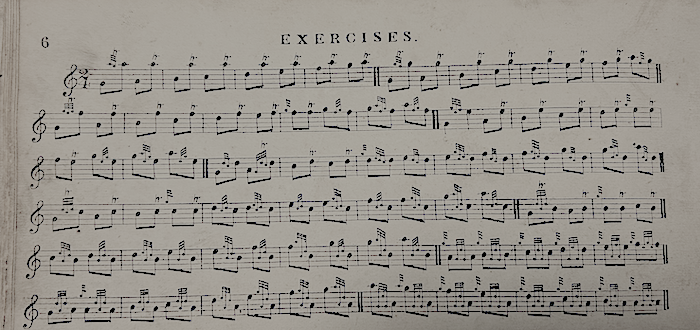
The sharp eyed will notice a basic system of abbreviations for doublings and the D throw. Here is an early example of space saving, devised either by Angus MacKay or the publisher, many years before the idea of symbols for gracenote clusters was taken up by General Thomason in his ‘Ceol Mor’ and later by the Piobaireachd Society.
Donald MacDonald Collection
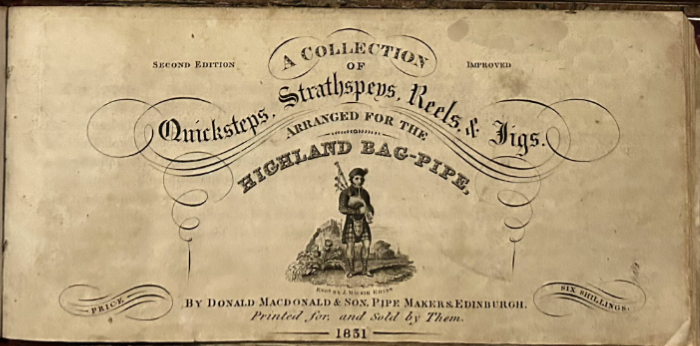
The Donald MacDonald collection of 88 ‘Quicksteps, Strathspeys, Reels and Jigs’ is marked and dated Edinburgh, 1831, and priced six shillings.
Six shillings! That’s an extraordinary amount when you consider that £1 (20 shillings) back then, is, according to the internet, worth £1,325 today.
That would mean Donald’s book costing north of £400 in today’s money. Surely that can’t be right. Would even the gentry have been able to afford this?
I presume, that like his piobaireachd book, this collection was targeted at the flutes and pianos of the drawing room and the after dinner musician of the well-off Victorian household.
Donald MacDonald’s Preface reads: ‘The present work has been finished for several years, and has been so long withheld, owing to the Publisher’s diffidence regarding his own abilities. He expected that someone better qualified for the undertaking would have entered on the task.
‘The experience of fifty years, devoted principally to the bagpipe, and a tolerable acquaintance with other kinds of instrumental music, embolden him to recommend the following tunes as played by himself.
‘It may be necessary to observe that this collection is adapted for the bagpipe only and that there are neither flat nor sharp notes marked, none such being required for that instrument.’
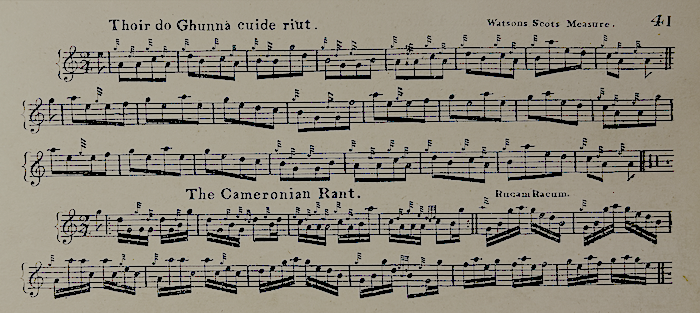
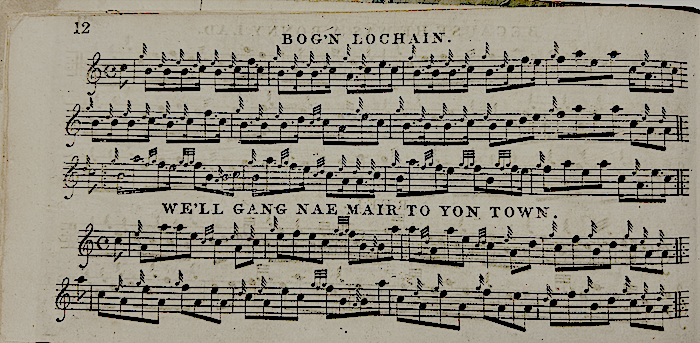
In both books tunes that we know today as multi-part ‘competition’ pieces are shown in their infant, two-measure, form. Here for example are the Cameronian Rant and Bogan Lochan:
As I say, all very interesting and thanks to Niall for the opportunity to study these early publication.