



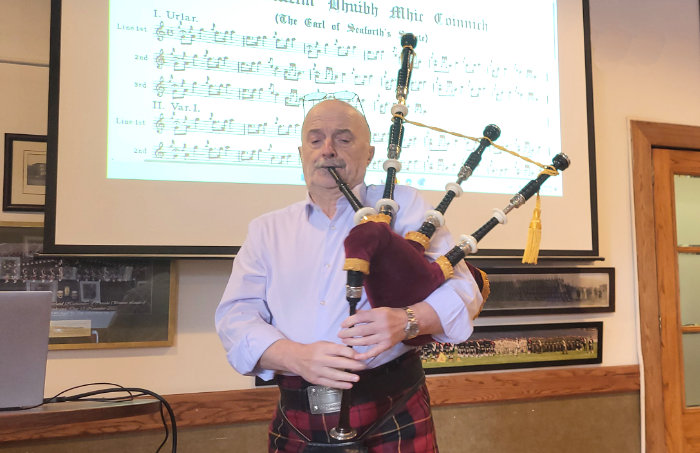
A piobaireachd workshop was held in the Sergeants’ Mess of the Argyll & Sutherland Highlanders in Hamilton, Ontario, on Sunday May 10, the day after the Livingstone Memorial Invitational Piping Competition.
As someone who has received piobaireachd instruction over many years starting with P/M Donald MacLeod and his protégé, Garth Neel, to Colin Maclellan, Ed Neigh, Willie Connell, and finally John Cairns, I can attest to the value of hearing from a wide range of accomplished instructors. Each brings something new to the analysis and discussion of the music.
by Brad Davidson, Vice President, PPBSO
This piobaireachd workshop, which was arranged for members by the PPBSO, was well attended and even a senior drummer took in the session.
Robert Wallace served as the senior judge during the proceedings the previous day, and as an accomplished performer and student of ceòl mòr, and also as President of The Piobaireachd Society, was more than qualified to share his understanding and insights into the music.
Rob began the session talking about the importance of passing along the knowledge and encouraged all in attendance to share generously – he also stressed that judging shouldn’t come at the expense of teaching. He acknowledged the move to have teachers who also judge not judge pupils, has caused some valuable teachers to pull back from teaching. In the age of cell phones and portable recording devices, every judge knows they are under maximum scrutiny and that any undue favouritism is unlikely to go unnoticed.
Some Highlights
Every piper can benefit from learning and playing piobaireachd. Piobaireachd performance aids development of memory and concentration while performing, never mind physical stamina as one is often required to perform for ten or more minutes at a stretch. The quality and steadiness of the bagpipe is another of the demands of this music.
In fact, Rob, as do I, encourages solo pipers who also play in a band to have a dedicated chanter and drone set up suited to solo performance as distinct from their band set up. Strength of reeds and quality of sound are likely to be very different.
Rob led the group through The Earl of Seaforth’s Salute and The Lament for the Children to illustrate many of the points he planned to make.
The delivery of the melody should reveal tension, release and resolution. Having a knowledgeable instructor to help identify where and how to deliver those effects is of immeasurable help when learning a tune.
One needs to strike a balance between delivering phrasing but without losing momentum in terms of pace and melodic flow. Keep the melody moving and don’t overdo the end of phrase pauses.
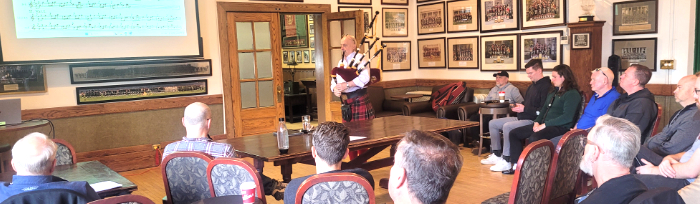
Rob had the assembled group sing together the melody of each line and variation to help establish these qualities before putting them to the practice chanter.
Transitions between variations need to be thought out in advance. Subtlety is the goal so as to maintain the magical effect you have created for your listener(s).
Rob’s view is that short-notes in piobaireachd need to be delivered softly, rather than cut as you would do in a strathspey or a reel, so as to blend with the established melodic flow.
Open up the embellishments for better melodic effect; they are part of the melody, after all. Too many players tend to execute them closed / tight and the melody suffers for it.
‘The sting’s in the tail’: the importance of having a reliable and consistent crunluath movement for a strong finish to your performance cannot be understated. This is also the point where your pipe can let you down for lack of steadiness, or possibly stamina.
Rob did not come across as dogmatic about how a tune must be played, instead focusing on the qualities one is trying to bring out to achieve maximum musicality. Many of these are easily transferred to tunes other than the two that we covered that afternoon.
In all, it was a very worthwhile afternoon. For some it was receiving some important insights for the first time; and for others, it was good to have reminders and reinforcement of practices you’ve already incorporated into your playing.
- This article first appeared on the Pipers and Pipe Band Society of Ontario website.