



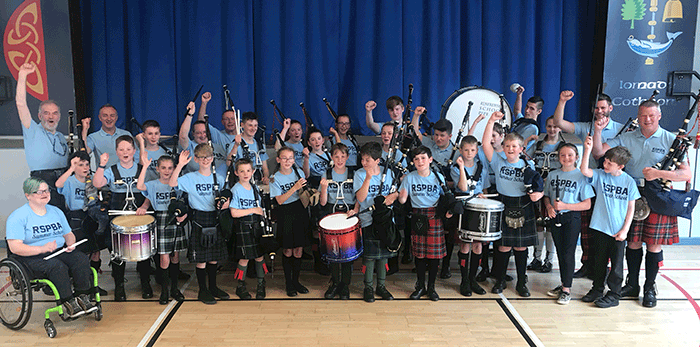
The RSPBA Pipe Band College must be the only one in the world which does not have standard teaching terms, and a recognised curriculum. It does run a successful summer school and conduct exams at various branches round the country, hardly sufficient for any ‘college’ worthy of the name.
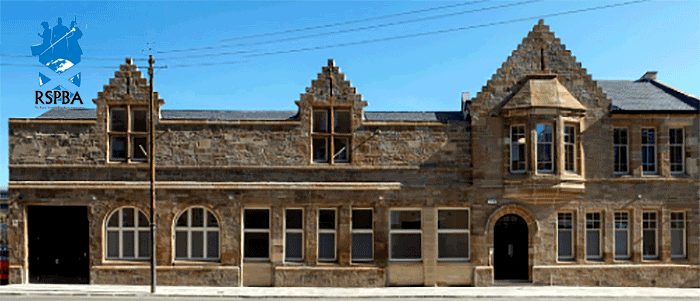
There are three Principals (excluding the Summer School Principal) instead of one – another first in world education. Yet still we have no Saturday morning classes at Headquarters in Glasgow (and why not Edinburgh, Aberdeen, Oban, Inverness), paid for by the Association and free to member bands.
By The Editor
There is public money available for teaching kids. The Principals should be tasked with sourcing this, setting up the classes, establishing the syllabi for piping and drumming (snare, bass and tenor) and then organising the exams/ assessments.
Northern Ireland seems streets ahead of Scotland in this regard. The RSPBA should be training pipers and drummers for their member bands as the RSPBANI do in Ulster. With a decent through-put of youngsters there should be less of a drop off in band numbers, and drum corps might be easier to come by.


Education cannot be left solely to individual bands, cash-strapped local authorities and the private schools. Of course they each have a vital contribution to make, but the RSPBA should be leading the way, not tickling round the edges with a College with no formal teaching (other than a one-week school) and a series of assessment days.
The RSPBA has it in its constitution that it should have a Pipe Band College. It follows therefore that the Board of Directors are duty bound to establish just that. Yet it appears to me that what we have at the moment is a College adrift from its basic function – education.
Yes, there are plenty of exams carried out but where is the teaching? Who are the teachers? The resource material is already there in the Structured Learning books. Maybe a bit dated, but available, soundly based on the fundamentals of pipes and drums, and free.
I was part of a review team commissioned by former Association Chairman Kevin Reilly to look at the whole business of the College and how it is run. Myself and esteemed colleagues John MacInnes MBE and Alastair Aitken OBE, two men steeped in the RSPBA’s traditions and duties, looked at every aspect of the working of the College.
From the outset our inquiries were conducted in a positive spirit. There was to be no blame game. Disappointingly, after more than a year’s work, and just as we were fulfilling our commission, the review was cancelled. I will leave the reader to ponder as to why.
Despite this, the new Chairman Bob Niven and his Board invited us to present our findings to their meeting last January and made us very welcome. We were grateful for that.

Our spokesman Alistair highlighted issues such as under utilisation of approved assessors, and a lack of clear vision for the College. We recommended separating policy and delivery roles, reducing the number of instructors and assessors, and an annual review at the AGM. We emphasised the need for a broader educational focus beyond qualifications and suggested more proactive fundraising.
In response, the recently published Board minutes state, ‘Some of the Directors who have experience with the College, supported these recommendations, noting the importance of education in maintaining the RSPBA’s relevance and competitiveness. The meeting discussed financial challenges and challenges related to assessments and training, the importance of assessing assessors and streamlining processes.
‘They reviewed the status of the Pipe Band College and addressed concerns about the Lead Principal’s acting as Convener, which conflicts with the constitution. Following discussions, the Board of Directors took a vote, and the outcome was that the CEO [Colin Mulhern] will undertake the role as Interim Education Officer, which encompasses serving as Convenor of the Pipe Band College.
‘Discussions centred on developing a strategic plan and enhancing the visibility of the Pipe Band College. Participants emphasised the need for a comprehensive approach to education, including both examinations and broader musical training.’
That all sounds promising. Perhaps the review team’s work will not have been in vain. Let’s hope the Board and Mr Mulhern can bring about real change beginning with paid instructors and Saturday morning classes at Washington Street. Until more teaching is instituted, the RSPBA Pipe Band College will remain something of a misnomer.