



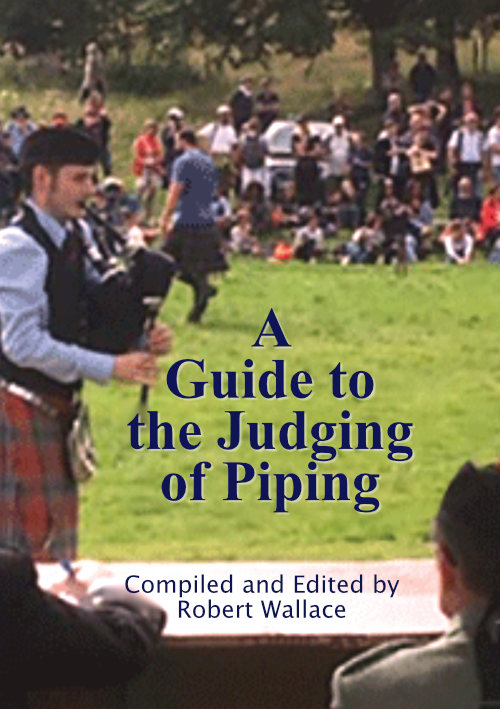
This attractive book is structured as follows: firstly a short Foreword by Robert Wallace; then ‘A Code of Practice at a Glance’; ‘A Guide to the Judging of Piping’ by Dugald Graham-Campbell, who was born in 1921, and Malcolm McRae’s comments on that work, ‘A Review of the Guide’.
Then we have, James Campbell’s ‘A Different Approach to the Judging Problem’, Colin MacLellan’s ‘A New Approach to a Judging Problem‘, David Murray’s ‘Judge Not, That Ye Be Not Judged – A Life on the Bench’, and Robert Wallace’s ‘Whatever Happens, Let Music Win the Day’.
By Francis Chamberlain
The book wraps up with ‘Notable Upsets on the Boards’ – in which enforced tuning times and the notorious tape recorder incident of 1974 feature – and closes with short biographies of the contributors.
What makes the book work so well is that, although Dugald Graham-Campbell’s Guide is at the heart of it, each subsequent article builds constructively upon it. It will inform both judges and pipers, whether competing or not.
The book broadly addresses three main topics: Firstly: who should be a judge? Secondly: how does a bench of judges pool its views to arrive at a prize list? Thirdly – and crucially: what factors should a judge take into account when assessing the merit of a performance?
Dugald Graham-Campbell: ‘If mistakes are once allowed, it becomes very hard to know where to draw the line.’ But Malcolm McRae: ‘Positive judging seeks to ensure that due credit is given to memorable, but imperfect, performances.’
Robert Wallace argues that judges should consider whether any error actually affects the musicality of the performance by, for example, breaking the melody line. Surely Robert’s view is given real weight by the inability of three experienced judges in 1974 to detect defects without the assistance of a tape recorder.
The conundrum, of course, is that judges will disagree as to whether an error spoils a tune and that, the less weight which is given to mistakes, the more subjective the judging becomes. But the book contains striking instances of judges arguing over whether a mistake was made at all, and it is evident that the overall musicality of a performance may be a far safer yardstick.
All this is fascinating. But the book is also most entertaining. Splendid historical photographs. A surprising emphasis on the need for judges to remain sober, at least during the competition. A photograph of Archie Kenneth actually wearing a kilt. The response of Sheriff Grant of Rothiemurchus to a competitor who told him he was playing Jim Tweedie’s Sea Legs: ‘Jim who’s what?’
Only turn poor players off the platform if they are also drunk. Feign interest even during an abysmal performance. Don’t be unduly swayed if the player has an alluring wife in the audience. Whether breaking down during a performance is the mark of a gentleman. Drinking Brasso when judging.
Everyone will be amused and instructed by this book.
- Francis Chamberlain was a criminal barrister for 20 years and now works as a mental health judge. He had piping lessons from Jim Caution and Iain Angus. He regularly attends the Piobaireachd Society Summer School on Skye.
- ‘A Guide to the Judging of Piping’, compiled and edited by Robert Wallace; Published by the Piobaireachd Society; 102 pages; £25; order here.




Not to be unduly swayed by a player’s alluring wife implies that there is a degree to which a judge could be duly swayed thereby…