


The 2026 British Pipe Band Championship, the first RSPBA Major of the year, was held at the Royal Highland Centre at Ingliston, to the west of Edinburgh, on Saturday 30th May. A total of 125 pipe bands had entered and, if my calculations are correct, 114 bands actually competed. The weather was sunny before turning dull, but thankfully there was only a short period of rain towards the end when umbrellas were needed.
By Alistair Aitken OBE
As the Royal Highland Centre is adjacent to Edinburgh Airport I expected that some of the performances might have been affected by planes taking off as it is a very busy airport. Surprisingly the effect was minimal, even as planes took off towards the west. I can only assume that the sound was reduced by the large number of buildings which now exist between the Royal Highland Centre [RHC] and the runway.
While in terms of atmosphere I still prefer Princes Street Gardens in Edinburgh, the past venue for the Scottish Championships, the space offered by the RHC is ideal for a large pipe band competition. The organisation of the event was to the normal high standards of the RSPBA and the locations of the four competition rings avoided any overlapping band sounds.
From a spectator perspective, however, much walking was needed if you wanted to hear bands in different grades. Only Ring 2 was close to the spectator stand (at the West end). One wonders if Ring 1, where Grade 1 was held, could have been adjacent to this stand so that more people could have enjoyed the performances from a seated position (and under cover when it rained). It is always difficult at the Grade 1 arena to secure a suitable listening position due to the large number of people who position themselves with their camping chairs well in advance. It becomes even worse when their umbrellas need to go up!!
Due to some mobility issues in my old age I restricted my listening to a few lower grade bands tuning up, the first two bands competing in Grade 2, and then the full Grade 1 competition. The first band to play in Grade 2 was the Royal Burgh of Annan and they produced an excellent technical and musical performance, which I thought was bound to be in the prize list (eventually taking second place).
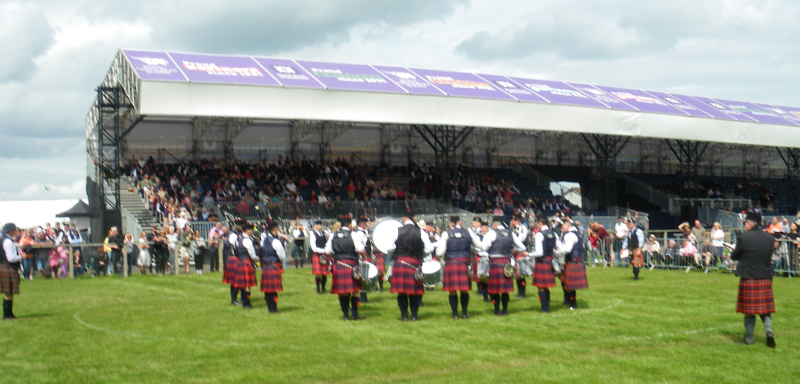
Grade 1 unfortunately had only nine entrants, six of which currently represent the only top-level pipe bands in Scotland. Much has been said about this subject online in recent weeks regarding the possible need to put a cap on player numbers.
I have no wish to get involved in the argument, but I thought it might be useful to compare numbers with the British Championships 20 years ago in 2006. Strangely there was exactly the same number of band performances then to this year (114). The main difference, however, was that there were 13 Grade 1 bands in 2006 (although still only eight from Scotland) and 20 in Grade 2 (compared to 13 this year).
Another interesting fact is that the number of six Juvenile bands has not changed, but five of the Juvenile bands in 2006 no longer feature in the Juvenile grade (Kintyre Schools, Boghall & Bathgate, Dunoon Grammar School, Inverclyde Juveniles and Erskine Stewarts Melville Schools). Perhaps the reasons should be investigated as part of the numbers debate as the Juvenile and Novice grades as where the majority of the future top players will come from?
I have no intention of commenting on the Grade 1 performances as the adjudicator results speak for themselves, being very consistent. Comments were made online about identical results at the competition at Dollar the previous week but my understanding is that RSPBA adjudicators are now allowed to discuss performances before finalising their results.
Grade 1 was a Medley competition and, from where I was standing a distance away, all nine performances were of an extremely high standard. They varied from theme-based tune selection; very lively demonstrations of technique and precision execution in both piping and drumming; traditional tunes with innovative variations; lengthy harmonies; different sound balances between pipes and drums; and in one case rather dominant varying-toned tenor drum contributions.
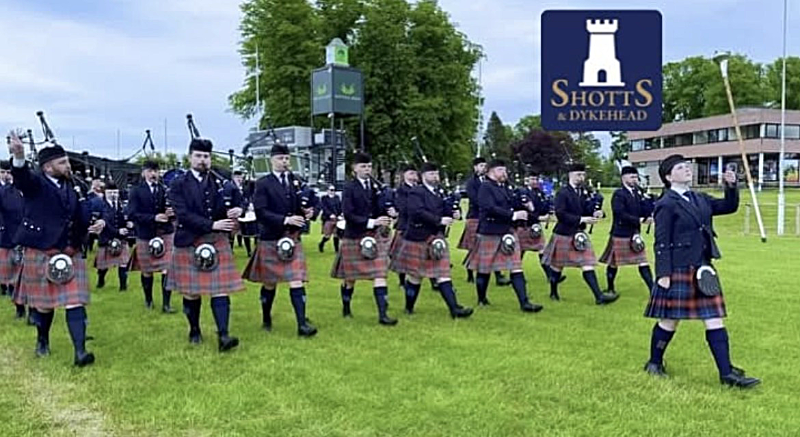
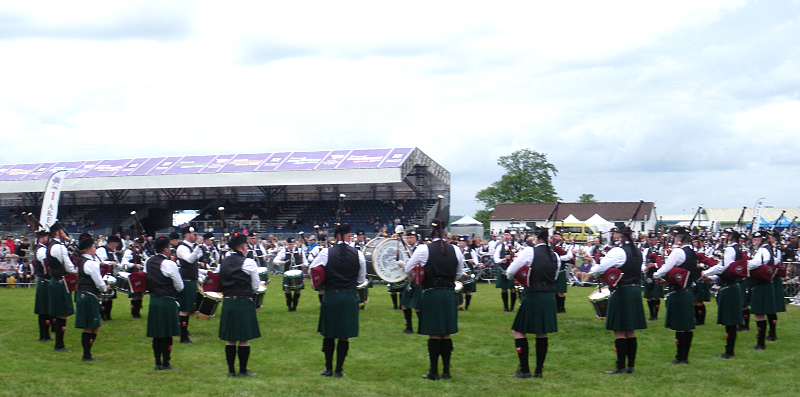
Listeners would have their own preferences as music affects the emotions of individuals in widely different ways. When I learned the results I felt rather sorry for the St Laurence O’Toole who finished in 7th place. The band was first to play and set a very high standard musically with its usual Irish slant and a particularly effective and haunting slow air. The picture of the band below shows the distance between the Grade 1 arena and the spectator stand:
Congratulations to Shotts and Dykehead Caledonia for their first Major win under the leadership of Pipe Major Emmett Conway.
The result has set the scene for what could yet prove to be a healthy and interesting battle of the top bands at the championships yet to take place, similar to what happened recently towards the end of the Premiership of Scottish football.
Congratulations also to all the prize winners in the other grades, details of which can be found in the results section of the RSPBA website www.rspba.org .