


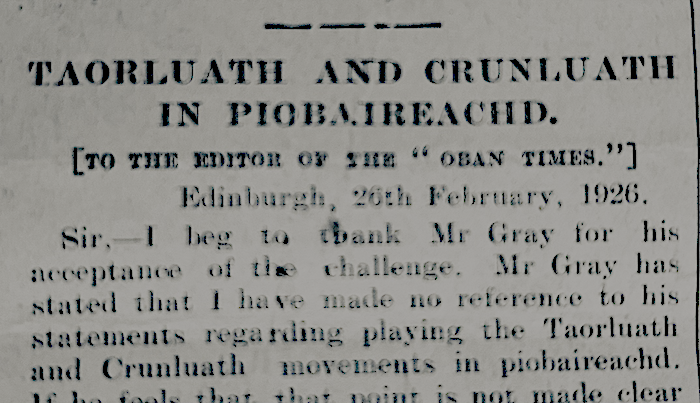
The final letter in the Oban Times correspondence of 1926 on the ‘redundant A’ controversy. It comes from a reader, Allan Thomson, from Govan, Glasgow.
‘I have been closely following the discussion in your valuable paper about taorluath and crunluath in pibroch [sic], and also crunluath a mach movements.
By The Editor
‘I admire the spirit and courage of Mr Grant in backing up the piobaireachd book of Angus MAcKay. I think Mr Grant is correct.
‘Another great authority on piobaireachd, Angus MacPherson, Invershin, Sutherland-shire, also says also says that Angus MacKay was correct, so that is good enough for me.
‘In my opinion, P/M Gray and Mr GS McLennan are trying to invent a new way of fingering and Mr McLennan backs it up because his father (as he says) was the inventor of this new movement.
‘Like Mr Grant, I was also taught Angus MacKay’s book and I think it was correct. My father taught me and he was taught by the late Michael McNeil, Arisaig, who knew piobaireachd by canntaireachd as well as the present notation.
‘I am also open to play pibroch the way I was taught and will do some at any time in front of Pipe Major McLennan, Mr Gray and any other pipe major in Britain for that matter.’
I hope readers have enjoyed this correspondence as much as I have. It is a very brave man who questions what Angus MacKay wrote, but we must remember that putting pipe music on the stave was still in its infancy when his book came out in 1838.
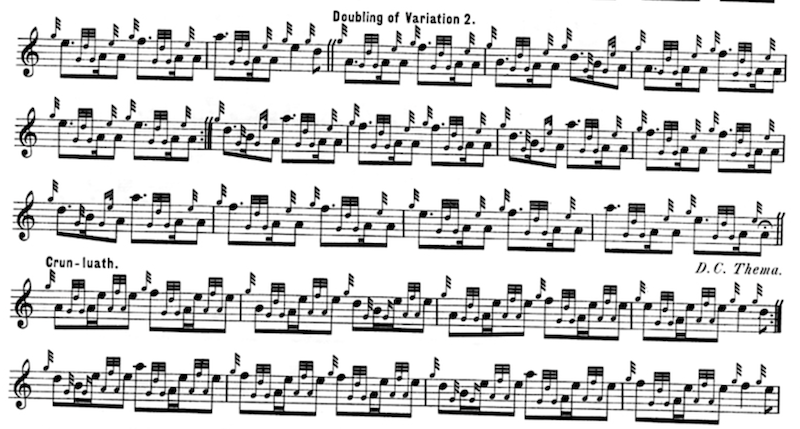
How do you account for the fact that he did not include the redundant A in the D movements, or that in the crunluath, it, and the following E gracenote, are written as semiquaver gracings?
Playing the redundant A is possible if you have the fingers for it, but it must never interrupt the rhythm of the movement be it taorluath or crunluath. Again, have a listen to Robert Reid. Many the contest he won on the strength of his crunluath. People were amazed at the crisp ripple. Like tearing linoleum, as big Ronnie Lawrie used to say.
If you want to try it go ahead. Play it slowly on the practice chanter like this, then try to build up speed:
When you get to the pipes forget about it. The merest glimmer might be there and give that little bit of body to your T&Cs that impresses your listeners. And as Bob Hardie used to say, a missed gracenote in your crunluath is less noticeable when you play eight instead of seven.

Heard a young fellow at Rosneath, in 2019, performing with a very clear redundant A in his taor and crun variations. Asked him who taught him, he told me he Callum Beaumont. Would love to hear it more often.