


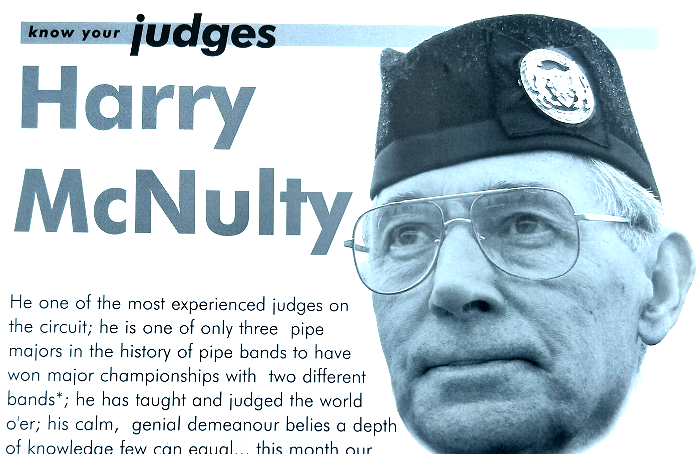
Harry McNulty died three weeks ago at the age of 93. He was a major figure in the pipe band world for most of his life. Although we have already carried his obituary, we thought it appropriate to re-run this article from Pipe Band Magazine dated July 2002 and carried under its ‘Know Your Judges’ banner….
He is one of the most experienced judges on the circuit; he is one of only three pipe majors in the history of band competition to have won major championships with two different bands; he has taught and judged the world o’er; his calm, genial demeanour belies a depth of knowledge few can equal…this month our spotlight falls on the inimitable Harry McNulty….
What age are you? Sixty-nine years young.
Judging qualifications? I have been involved in pipe bands in a playing capacity for 40 years as a piper, pipe sergeant, and pipe major. I passed an RSPBA exam in theory and practice whilst pipe major of the Lothian & Borders Police, British Caledonian Airways and Scottish Power. I judged sporadically in the UK, Canada, and the Middle East between 1977 and 1991, thereafter judging on a regular basis for the RSPBA having retired from pipe band competition.
Main band experience? I spent 20 years in the Edinburgh City Police band as a piper, the band winning four World Championships in 1963, 64, 71 and 72. I became pipe sergeant in 1975 the year we won the World Championship at Corby, England, under P/M Iain McLeod. Iain retired in 1976 and I became pipe major of the band.
My first competitive season was 1977. We gained fourth place at the Worlds at Aberdeen and in the ensuing years managed to keep in the prize list. I suppose 1979 was the band’s best year as we won the Scottish Championship at Princes Street
Gardens in Edinburgh, were second in the British, second at Cowal and third in the Worlds at Nottingham. Our trip that year to the Canadian National Exhibition in Toronto gained us a reputable third prize.
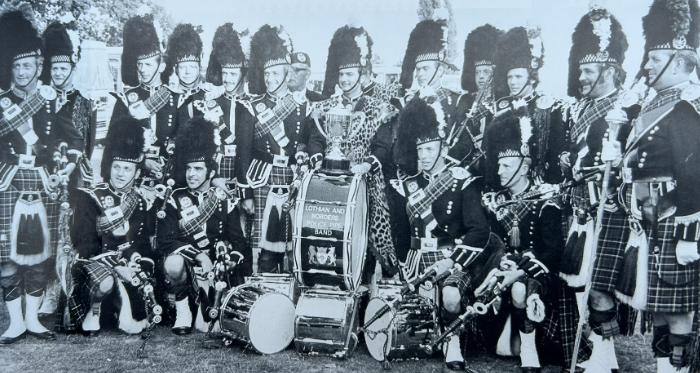
In 1982 I became P/M of B/Cal Airways. This was quite a challenge to me to be involved with so many great solo players such as the late P/M Angus MacDonald, Stuart Liddell, Ronnie McShannon, Tom Johnstone, John Patrick, and Alan MacDonald to name but a few. I must say they were a joy to work with, as were most of the others.
In 1987 B.Cal were taken over by British Airways and this meant looking for a new sponsor. In 1989 this was obtained from Scottish Power. It was at this stage we started to make inroads towards the top three in the prize list, winning the Scottish Championship twice, Cowal and runner up at the Worlds. Our drum corps under Eric Ward also won the Champion of Champions title. This all happened between 1989 and 1991.
Any other band experience? I did my National Service in the Royal Scots at Dreghorn Camp, Edinburgh, between 1951-53. After initial training I was accepted into the Lowland Brigade piping school under the direction of P/M George Stoddart. At this stage I was very much a novice piper. One of the members of the band was Tom McAllister Jnr. who was responsible for setting up the pipe corps.
It was a great experience to watch Tom at work even at this early stage of his life. It obviously helped him in later years when he became pipe major of Shotts & Dykehead. I learned a great deal just watching him.
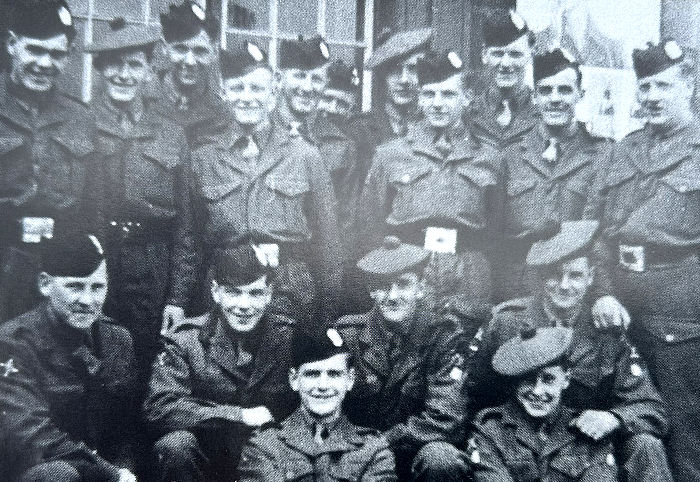
When I was demobbed in 1953 I could at least say I could now play in a pipe band. In July of 1953 I returned to the family business of Wm. Sinclair and completed my apprenticeship as a bagpipemaker. In 1954 I joined the TA 7th/9th Royal Scots Pipe Band known as the ‘dandy ninth’. I was there until 1955. About this time Iain McLeod frequented Sinclair’s shop and asked me if I would fancy joining Edinburgh Police with a view of eventually becoming a member of the pipe band.
I found it very appealing to join such a famous band and in December of 1955 I duly joined up. In 1956 I became a member of the band under P/M Donald Shaw Ramsay. Though they won the Worlds in 1954, the band did not compete from 1955-1957 for reasons unknown to me. The band resumed competing again under P/M John D Burgess.
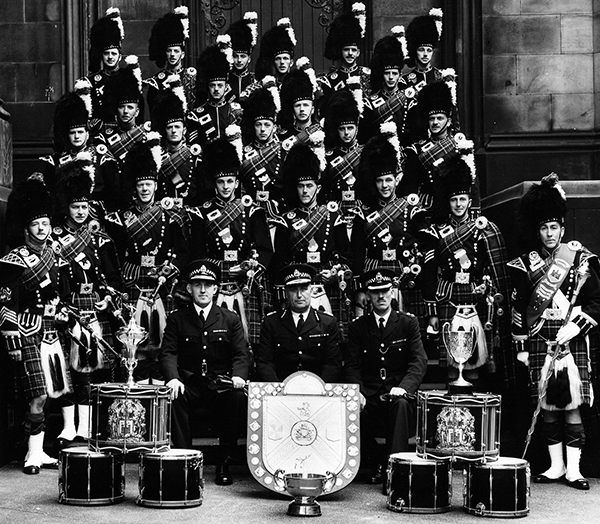
By this time I was ready to compete with them and we had a successful season winning the Scottish Championships, Cowal, and achieving second at the Worlds. Iain McLeod became pipe major in 1959 and the band had its most successful period until his retirement in 1976.
Which bands influenced you in your formative years? About 1949, being 16 years old, I used to accompany my grandfather, Wm. Sinclair Snr., to some Shotts practices. He was a great friend of Tom McAllister Snr. and since 1933 they had made Shotts a formidable force in the pipe band world.
These sojourns were a lesson for me in the setting up of a pipe corps: all the same make of chanters and the same pipe and drone reeds. I learned what terrific sound could be accomplished with the correct blend of chanter and drones. I must have been subconsciously influenced and took a great interest in band work at this time.
On one occasion I went with my grandfather to Dundalk in Ireland where Shotts were competing. They were placed first and won £100 in prizemoney, quite a sum in those days. I can even recall they played the march Glen Caladh Castle as part of their march, strathspey and reel. In the years which followed, JK McAllister and Tom Jnr. kept up the standard set by their father.
Whilst playing for the Edinburgh City Police, Muirhead and Sons under Bob Hardie were a force to be reckoned with, winning five Worlds titles in a row. Their integration, faultless fingering and melodic MSRs was something never to forget. To continue that standard on regular basis was a feat to be admired.
During 1976 another band was making everyone sit up and take notice: Ian McLellan and Strathclyde Police had arrived. Unfortunately for me I was to cross swords with Ian in a playing sense much to my cost. I don’t think I need say any more about this band other than that they were a prize-winning machine. They had excellent sound and great finger technique and I almost forgot their 13 World Championship titles.
Did you have any other preparation for judging? I was fortunate in having served under such famous pipe majors as Donald Shaw Ramsay, John Burgess and Iain McLeod. If you couldn’t learn anything from those three then you hadn’t been paying attention.
I would never have classed myself as a solo piper but Iain McLeod always encouraged members of his pipe corps to enter solo competition. I can remember nine of us entering for the Northern Meeting at Inverness one year. Iain won the Silver Star for MSR, John Percival the marches, the late Colin Forbes was placed in the marches, and Laurie Gillespie took the jigs. I managed fourth in the marches the year John MacFadyen won it. Inverness then became a regular outing for us all after that.
Next excerpt: What I’m looking for from a band and my most memorable band performance.