



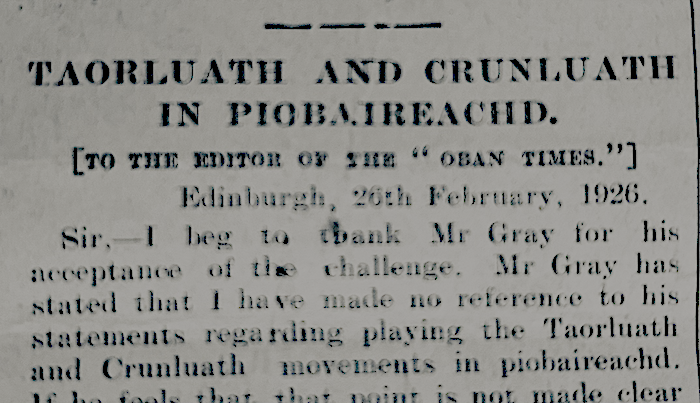
What is the ‘redundant A’ ? Whole generations have come and gone since the controversy was aired on the pages of the Oban Times a century ago. The correspondence reached its apogee in 1926 with none other than the great GS McLennan weighing in. We run a series of letters to the newspaper, including his, beginning today.
By The Editor
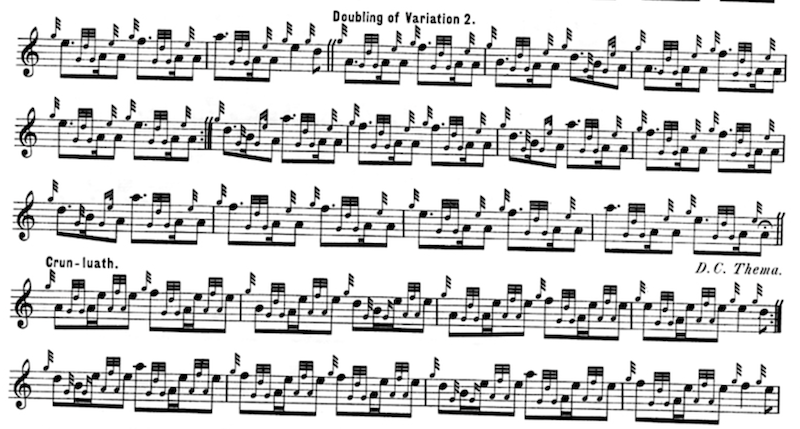
Firstly we need to establish what the cause of all the heat was. Basically it is the insertion of a low A gracenote, made by lifting the little finger before the final E gracenote of the taorluath, or, in the case of the crunluath, before the E and F gracenotes to low A.
No modern collection of pipe music writes these movements showing this ‘extra’ low A gracenote. However many older books of ceòl mòr and ceòl beag depict them just so. And importantly, as we shall see in terms of the argument, Angus MacKay did too:
The redundant A was taught by P/M Robert Reid (see the archive recordings on the Piobaireachd Society website), and taught to the writer by Reid’s pupil, RG Hardie – with the crucial caveat that the additional gracenote must never interrupt the rhythm of the movement.
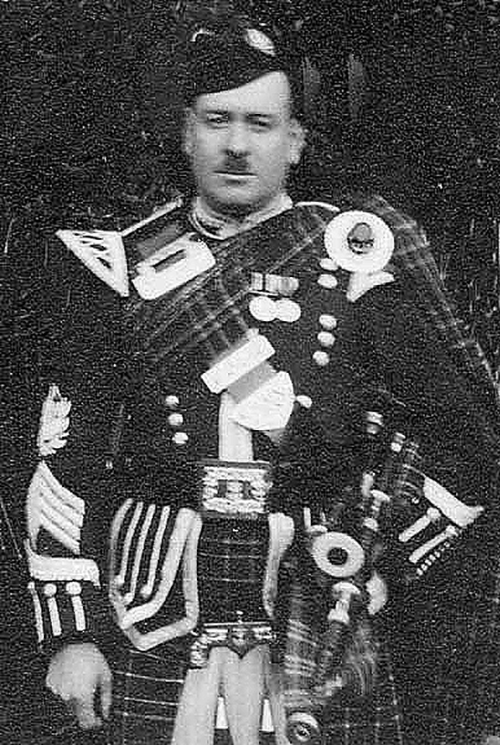
But to the Oban Times, the crofter’s tablecloth as one wit deemed it, for our first letter. It is dated 26th February 1928, and is from John Grant, one time tutor for the Piobaireachd Society’s Army Class.
Grant was clearly quite a character. Unperturbed at being dismissed from the class because the students didn’t like his lessons, he went on to produce a book, ‘Piobaireachd, Its Origin and Construction’, 1915.
In his letter he is responding to a challenge from P/M Willie Gray, Glasgow Police, to publicly debate the vexed matter of the redundant A:
‘I beg to thank Mr Gray for his acceptance of the challenge. Mr Gray has stated that I have made no reference to his statements regarding playing the taorluath and crunluath movements in piobaireachd….
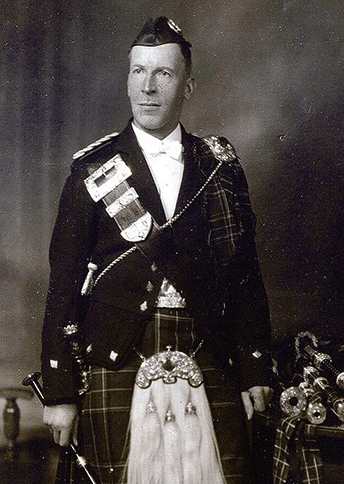
‘I have pleasure in again re-assuring him that it is the taorluath and crunluath movements I am going to play. I have no intention of withdrawing my pledge, already given, that I shall leave no stone unturned to prove my point.
‘I must thank the Glasgow Correspondent of the Oban Times for the high tribute which he pays to Mr Gray and myself in the Glasgow Letter this week.
‘Let me add, in conclusion, that I think it is premature for Mr Gray to state the conditions under which he will ‘consider the test of no account’. He will not be my only judge any more than I shall even dream of being his only judge.
‘I invite Mr Gray to the demonstration at Edinburgh in a friendly, and not in an antagonistic, spirit. I am convinced that when we meet we shall both learn a lesson in regard to the great music of the celt, which we both love. It may be the dawning of a new era in the preservation the ancient art of piobaireachd.’
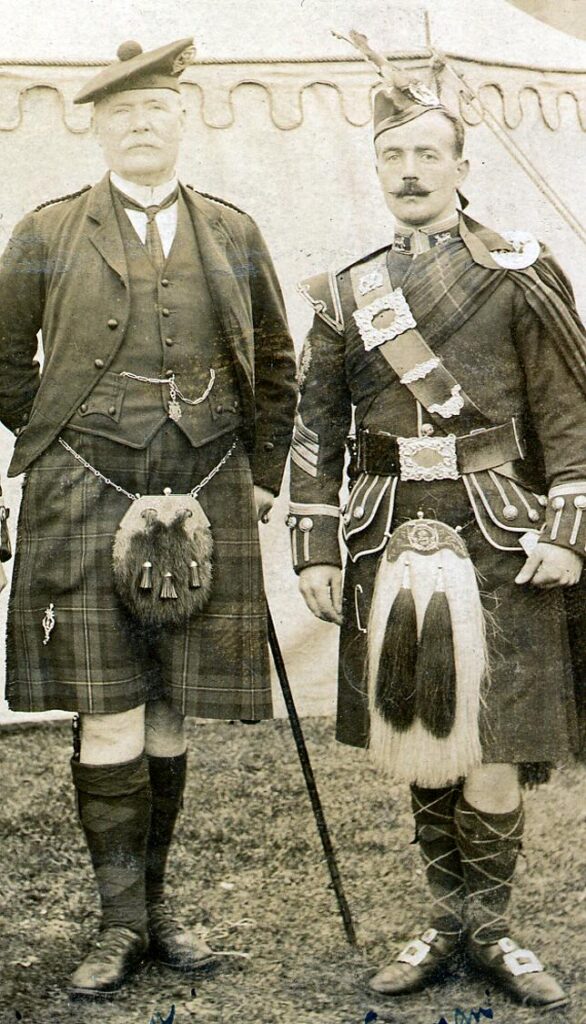
In the same issue of the newspaper GS McLellan, writing from his home in Aberdeen a few days later, begins his response:
‘I shalll be obliged if you will grant me a small space in your popular paper to reply to the letter Mr John Grant…I have to thank Mr Grant for his kindly reference to my father and I am glad to know they were such friends in spite of their opposite views.
‘I am rather afraid Mr Grant has made a mistake in understanding my father to have said that he was taught taorluath and crunluath with the redundant low A. He was not, and this why it was omitted from all his writings.
‘Mr Grant further says that he and my father got their piping from the same source. Surely this is not correct. Anyhow, my father has often stated from what source his piping came; so far as I am aware, Mr Grant never has.
‘I may assure Mr Grant that the redundant low A in taorluath and crunluath does not appear anywhere in my father’s MSS, and I never at any time knew him to write it.’
- To be continued.
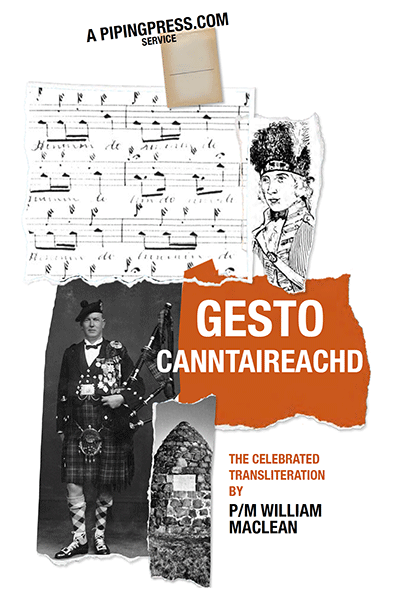
Gesto Collection – Transliterated by P/M W MacLean
This is a dowloadable copy of the 1910 work transliterated from the Gesto Canntaireachd by P/M William MacLean, Kilcreggan. He has taken the canntaireachd and interpreted it in such a way as to provide us with scores of tunes in settings that are eminently playable by today’s pipers. There is a fulsome introduction and you can read more about the pipe major here. This volume is offered as a pipingpress.com service and is taken from a copy of the original…