





The word ensemble, translated from the French, means ‘together.’ How together are the various sections of the pipe band: the pipers, the side drummers and the bass and tenors?
In current competition format, how clearly defined are the roles of the piping, drumming, and ensemble judges in measuring this togetherness?
By Alan Jones
Who measures it within a given section and between the various sections? Is there any overlap of roles and if so, why?
In my view, it is unreasonable to assume that just because a person is significantly proficient in playing the pipes, or has had a successful history in pipe corps leadership, they automatically have the requisite skills to judge pipe band ensemble.
In an MSR competition, pipers play tunes that are, basically, standardised. Rhythmic and melodic format is usually ‘fixed’ and seldom open to major change despite ensemble limitations that they might have.
Consequently pipers, in general, are not experienced in listening to the drums, and in understanding how they function and integrate rhythmically, melodically, and sonically, with the pipes.
Nor can they act on that understanding, or lack of it, to help bring the various sections of the band together musically – the essence of ensemble.
Even the very best piping composers seldom consider, or understand, the impact that their tune might have on pipe/drum ensemble. Experienced lead drummers, however, in most cases, do.
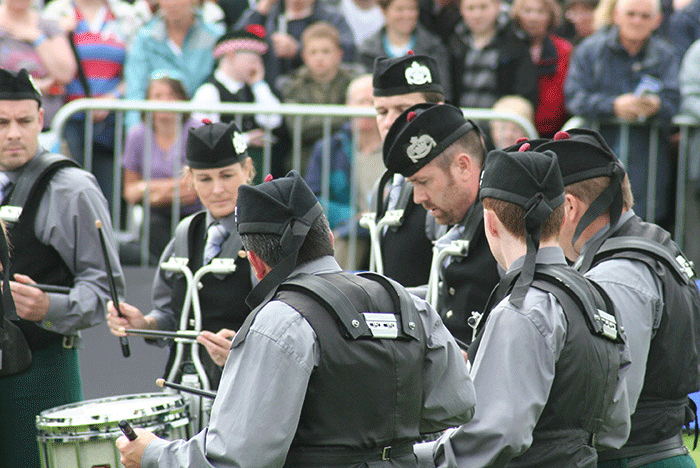
Writing a quality pipe band drum accompaniment is not easy. It requires specialised understanding of the ways in which the pipes and drums come together and of the ensemble limitations that exist between them.
It also takes a significant amount of time to build up the experience to do the job well. If a judge has little or no understanding of drum music, and thus no experience in writing drum scores, how can that judge follow and compare piping and drumming rhythms simultaneously?
Also, without an appreciation of the significant limitations that can sometimes be placed on the drum score writer by pipe tune selection, how can one be qualified to judge the resulting levels of ‘togetherness’ of these two instruments with objectivity and rigour?
And how does an ensemble adjudicator consider this togetherness, or lack of it, using language a lead drummer would understand?
Without this understanding and knowledge, the ensemble judge just becomes another piping judge with the potential to skew results in favour of any band that is stronger (or penalise any band that is weaker) in piping.
An entry-level requirement for anyone wishing to qualify as an MSR ensemble judge should be something like:
1 The candidate is able to write a simple, rhythmical, musically correct, side drum accompaniment to each of any given eight bars of Grade 1 MSR pipe music.
2 He/she should be able to defend that composition from a pipe and drum ensemble integration perspective, and be able to communicate this defence in a musical language that a lead drummer would understand.

Any pipe band judging panel, at any level, should comprise two piping adjudicators responsible for determining the quality of the performance ‘within the circle’. Piping judges should completely ignore the drummers.
There should be one drumming judge responsible for determining the quality of the performance within and between the sides, bass and tenors. The drumming judge should completely ignore the pipers.
There should be one ensemble adjudicator responsible for determining the level of togetherness between the pipers, drummers (sides/tenors/bass) only. The ensemble judge should completely ignore the quality of playing both within the pipe section, and within the drum sections.
* This article is abridged from the author’s website Pipe Band Ensemble. Alan Jones began learning the side drum aged 12 with the Manawatu Scottish Pipe Band, in Palmerston North, New Zealand. By his early twenties he had gained a national solo drumming title, two national pipe band drumming titles (as a corps drummer), and had travelled to Scotland, spending a year playing a full competition season in Grade 1. Upon returning home to New Zealand, Alan and his wife (whom he met in Glasgow) settled in Hamilton, where he was to become the lead drummer of the local band, a position that he held for many years.

‘Highland Bagpipe Music’ by Donald Morrison – digital book
This book was first produced shortly before Donald died in 1988. Languishing out of print, it surfaced in 2021 following contact between Piping Press editor Robert Wallace and Donald’s daughter Sheona. Sheona agreed that it should be offered to the piping public once more at nominal cost, the aim being to preserve her father’s musical legacy. Donald Morrison was the complete piper a fine teacher, composer and soloist. He won the Gold Medal, the Bratach Gorm and many other top…


The most sensible thing I have ever read on ensemble judging.
Thanks John.
Readers might also like to check out the second part of the article, which currently features on the home page of my website: pipebandensemble.com
Alan Jones