



We continue our look at the early days of the pipe band movement….
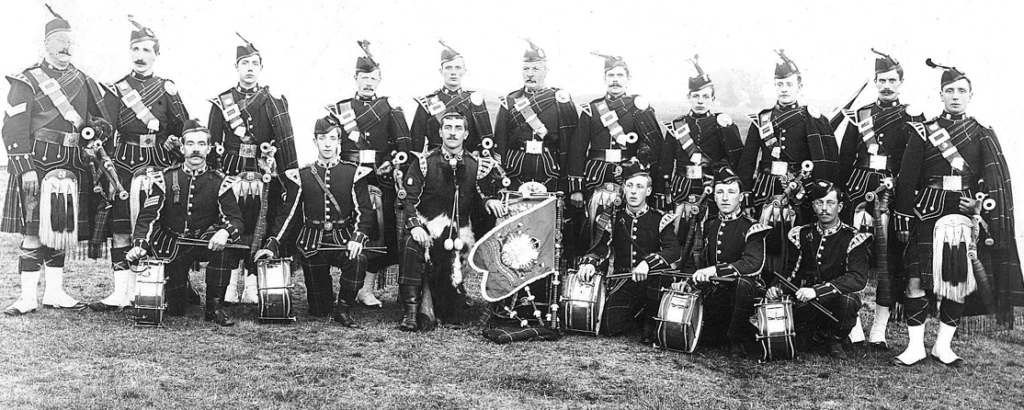
One of the first pipe band competitions was held at Ibrox Stadium in Glasgow in the 1890s under the auspices of the Govan Police sports committee.
The winners were the Govan Police pipe band themselves, and among the bands taking part were volunteer battalion bands under Pipe Majors John MacDougall Gillies and Farquhar MacRae.
The next competition was arranged by Glasgow Corporation at Bellahouston Park, and again Govan Police were first. There was another contest at Ibrox in 1901 billed as the British Championship. Govan Police were first and Wallacestone second, but only two bands played.
The first World Championship was held at Cowal in 1906. There had been solo contests at there since the Gathering was first held in 1894. Then, at a committee meeting in May 1906, a local master mason, Malcolm MacCulloch, suggested that a pipe band contest should be held that year.
It was agreed and decided that each band should have not less than eight pipers and not more than twelve, with an optional number of drummers.
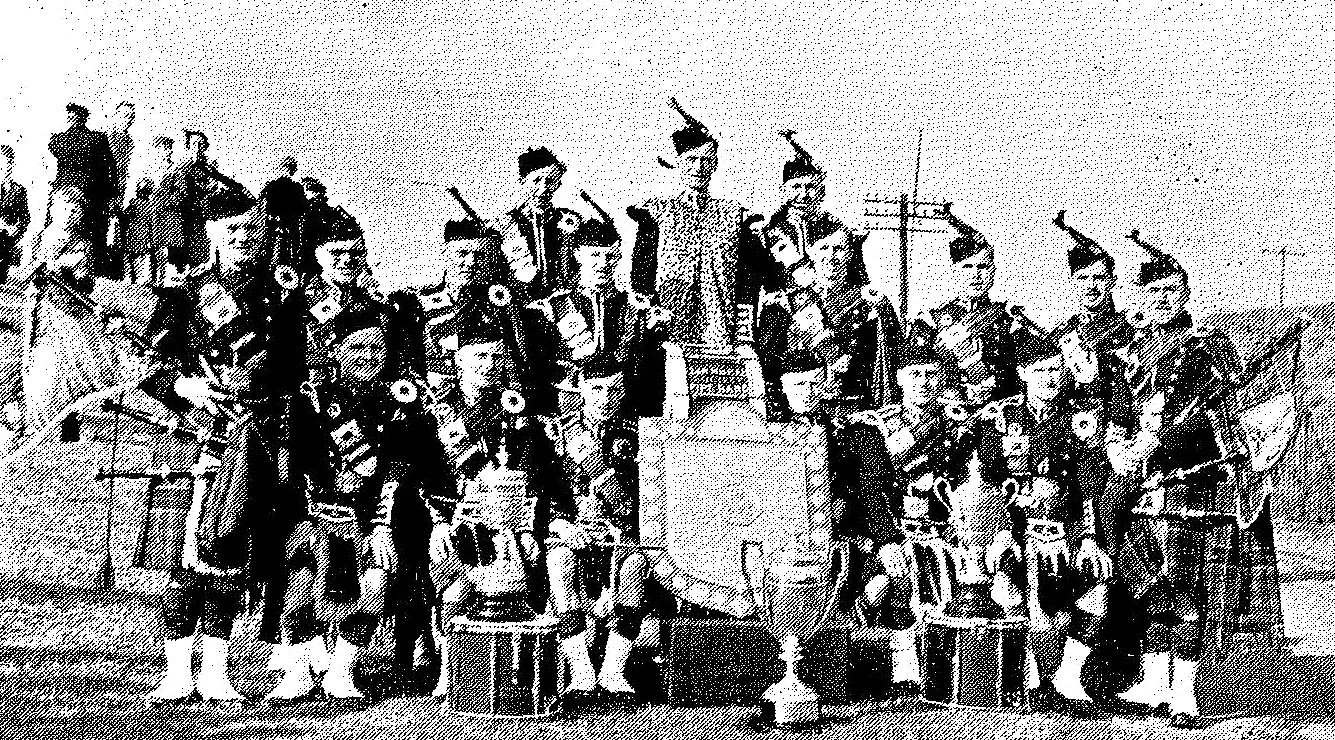
Prize money was fixed at £10, £5 and £2.10s. Money was raised by public subscription to pay for a shield costing £43 18s 6d. Queen Victoria’s daughter, Princess Louise, married to the Duke of Argyll, helped design it and it was named the Argyll Shield.
This was the first prize in the Grade One competition at Cowal until the Championship was withdrawn in 2013.
There were lots of band competitions at this time. During the 1920s and 30s a contest for the Championship of Glasgow was held in spring each year, indoors, in the Winter Garden of the Peoples’ Palace on Glasgow Green where the Worlds are held today.
Then anyone could run a pipe band contest and each promoter could make his own rules and have his own choice of judges. Except at Cowal, bands were not graded, although there were sometimes separate events for juvenile bands.
Cowal had open competitions, civilian band competitions, Territorial band competitions and events for adult and juvenile bands, which had not won a prizes during the previous three years.
As we hear from old recordings, pipe band performances at that time were more informal than at the present. For example the pipe band start as we know it today was unknown, and there were no sets of matched chanters. (Listen to the first ever recording by a pipe band – Govan Police – here.)
As described in earlier instalments of this history, the RSPBA was formed in 1930. The Association had no magazine of its own to spread the word until 1948, but the Piping and Dancing magazine had a regular column of SPBA news from their foundation in October 1935.
The first SPBA column in Piping and Dancing, written by Donald McIntosh, began by welcoming the new journal and went on to thank the Daily Record and the Oban Times for providing column space previously.
The Association decided to hold an indoor contest in January 1937 for quartets and solo drumming which would be open to all players of member bands.
This competition proved very popular and it became regular event during the winter months of future years. In August 1938 it was reported that several newspapers were incorrectly describing the SPBA Grade One Championship at Renfrew as the World’s Championship.
This was denied by the Association which stated that, ‘as the ruling authority on pipe band contesting, recognise the Dunoon contest as being for the World’s Championship and no other contest is entitled to use that coveted title to describe their contest.’
At the end of 1938 there were almost ninety member bands in the SPBA. The 1939 contest season was almost over when war came, causing the cancellation of the last event at Pitlochry.
- To be continued.
The Glasgow Collection of Bagpipe Music
Now in its fifth reprint, this book of ceol beag first appeared in 1986. Tunes are: Mrs John MacColl, James MacMillan of Victoria – British Columbia, William MacDonald – Benbecula, Men of Argyll, Detroit Highlanders, Dumgoyne, Peat Harvest, Captain Grant, Braemar ‘Wali’, A Parting Glass, Ancient Clan March, Kitty Lie Over, MacDonald of the Isles, Battle of Sheriffmuir, Wellfield, Dunaskin Glen, Wallace’s Farewell to Kuratau, Farewell to Muirheads, Loudon’s Bonnie Woods and Braes (air), Achmore Loch, My Brown Haired Girl,…

My grandad was an original member of the Colinton and Currie Pipe Band. My dad and oldest brother were ialso nvolved in it through the years. He took his bass drum to the front in WW1. I believe it now resides in the SPBA headquarters.
I’m sure Ian McMillan was on bass at Ibrox that day
What an amazing and magnificent spectacle it was to watch and listen to the Cowal Grade 1 winners playing down the road, after the results were announced. Indeed, all the prize winning bands proudly marched and played from the stadium back to the ferry terminal, in the case of the Grade 1 winners marching with the huge Argyll Shield being carried in front of the band, and playing “crowd-pleasing” tunes. Argyll Street in Dunoon was “heaving” with masses of pipe band supporters, locals were sitting on their window ledges, and young lads climbed the lampposts to get a better view. An amazing pipe band extravaganza, sadly now confined to history