


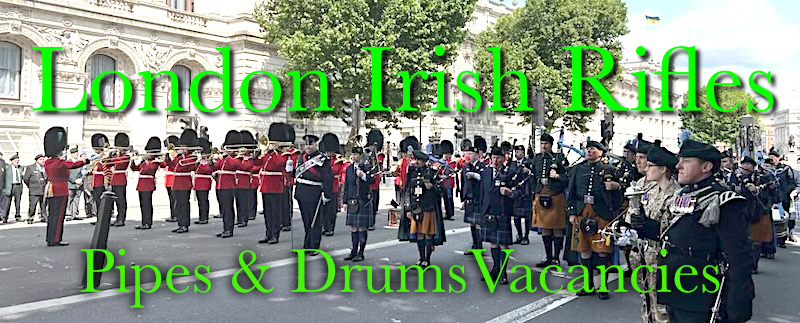

The following is taken from a special supplement produced to mark the 75th Anniversary of the RSPBA in 2005. It was written by piping historian Jeannie Campbell and edited by Robert Wallace….
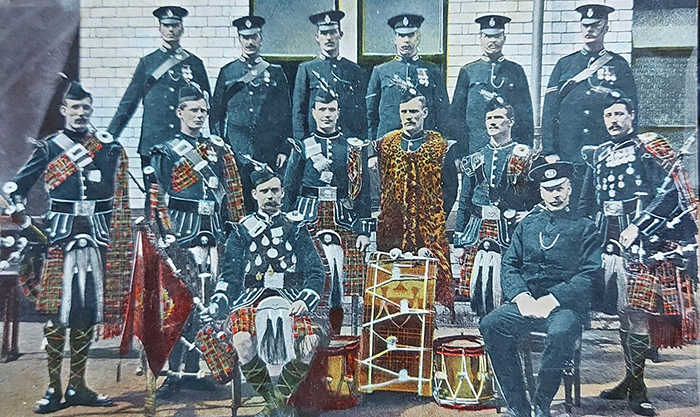
Though the bagpipe had been in use in the Army for a long time the pipe band as we know it did not come into existence until the mid 19th century.
Marching in step was introduced, at first on the parade ground, and later, as roads improved, for ordinary marching. When this new concept of marching in step was introduced it was discovered that the soldiers found it easier to march to the fifes and drums, or the military band, than to the pipers.
The beat wasn’t always obvious in pipe music, but the military band had a loud thump from a bass drum so everyone could keep in time. To solve the problem the drummers were detailed to accompany the pipers as they did the fifers.
There is evidence of pipers and drummers playing together from about 1848. During the Crimean War 1854-56, the official strength for each Highland regiment was a Pipe Major and five pipers.
The pipers used to march behind the drums and fifes and this was a subject of argument for many years, until, in 1871, Queen Victoria intervened and decreed that the pipers must always lead. By this time there were bands of pipers and drummers in the regular Army and in many volunteer battalions.
The first bands outside the Army date from the 1880s and some of today’s best known outfits can trace their history back to this time.
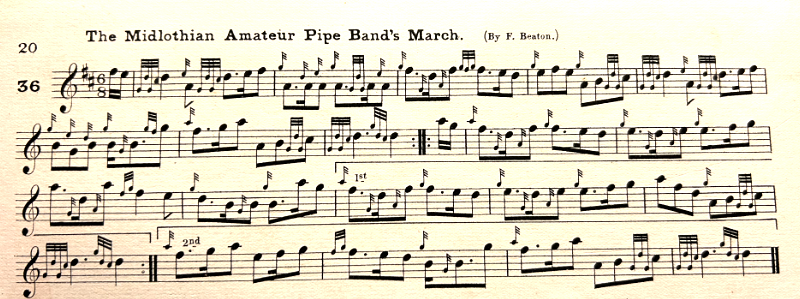
A tune named the ‘Midlothian Amateur Pipe Band’ was published in David Glen’s Tutor in 1881 so presumably there was a band of that name at the time.
Govan Police Pipe Band was one of the earliest ‘civilian’ bands. It was formed in about 1883 under Pipe Major William Bremner who was followed in 1890 by Pipe Major Drysdale. It was a common sight in the 1890s to see the pipers and dancers being conveyed to functions in a four in hand coach drawn by grey horses.
The average height of the band members at the time was six feet two and a half inches so they would have been an impressive sight. In 1912, when Govan became part of Glasgow, the band became the Glasgow Police Pipe Band and changed to the Royal Stewart tartan.
An Edinburgh police band first came into existence in 1882 as part of the Edinburgh Municipal Band, with a drum section drawn from the Gas and Transport departments. About 1890 it was reorganised as the Edinburgh City Police Pipe Band.
Wallacestone Pipe Band, founded in 1887, was one of the first truly civilian bands, having no connection with the police or the army.
Another early band was the Colinton and Currie band also founded in 1887. Inveraray Pipe
Band was known to be in existence by 1890. Coalbum Rechabite Pipe Band can be traced back to 1894 during a miners’ strike.
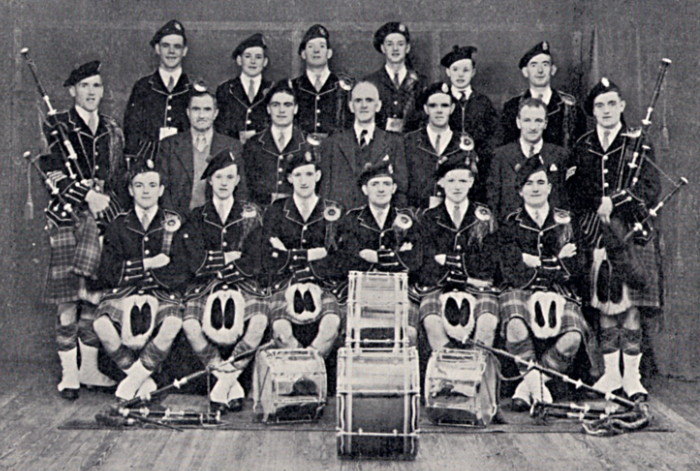
The men were unemployed for 13 weeks during the summer, so one of their number began to teach the others. The band actually came into being in 1898.
The first civilian band in England was almost certainly the Accrington St John’s Ambulance Pipe Band formed in 1898.
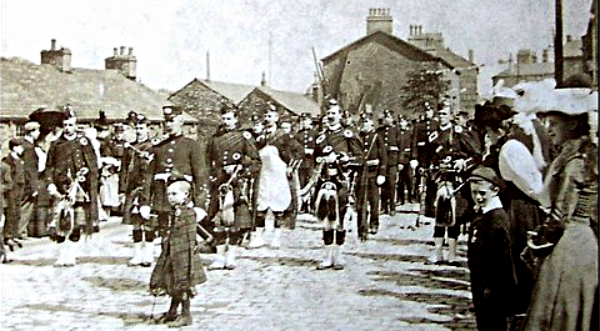
The Boys Brigade was founded in Glasgow in October 1883 and quite soon had started pipe bands in its
various companies. The BB played an important part in the history of piping.
By the tum of the century there were pipe bands in twelve battalions of Highland regiments, eight Scottish regiments, three battalions of the Scots Guards, twenty militia battalions, forty or fifty Volunteer battalions, plus schools, cadets, Boys Brigade and civilian bands.
Many were formed in the early years of the century, including Bowhill founded in 1902, Shotts and Dykehead 1906, Stonehouse pre-1909 and Camelon 1913.
- To be continued.
The Glasgow Collection of Bagpipe Music
Now in its fifth reprint, this book of ceol beag first appeared in 1986. Tunes are: Mrs John MacColl, James MacMillan of Victoria – British Columbia, William MacDonald – Benbecula, Men of Argyll, Detroit Highlanders, Dumgoyne, Peat Harvest, Captain Grant, Braemar ‘Wali’, A Parting Glass, Ancient Clan March, Kitty Lie Over, MacDonald of the Isles, Battle of Sheriffmuir, Wellfield, Dunaskin Glen, Wallace’s Farewell to Kuratau, Farewell to Muirheads, Loudon’s Bonnie Woods and Braes (air), Achmore Loch, My Brown Haired Girl,…