


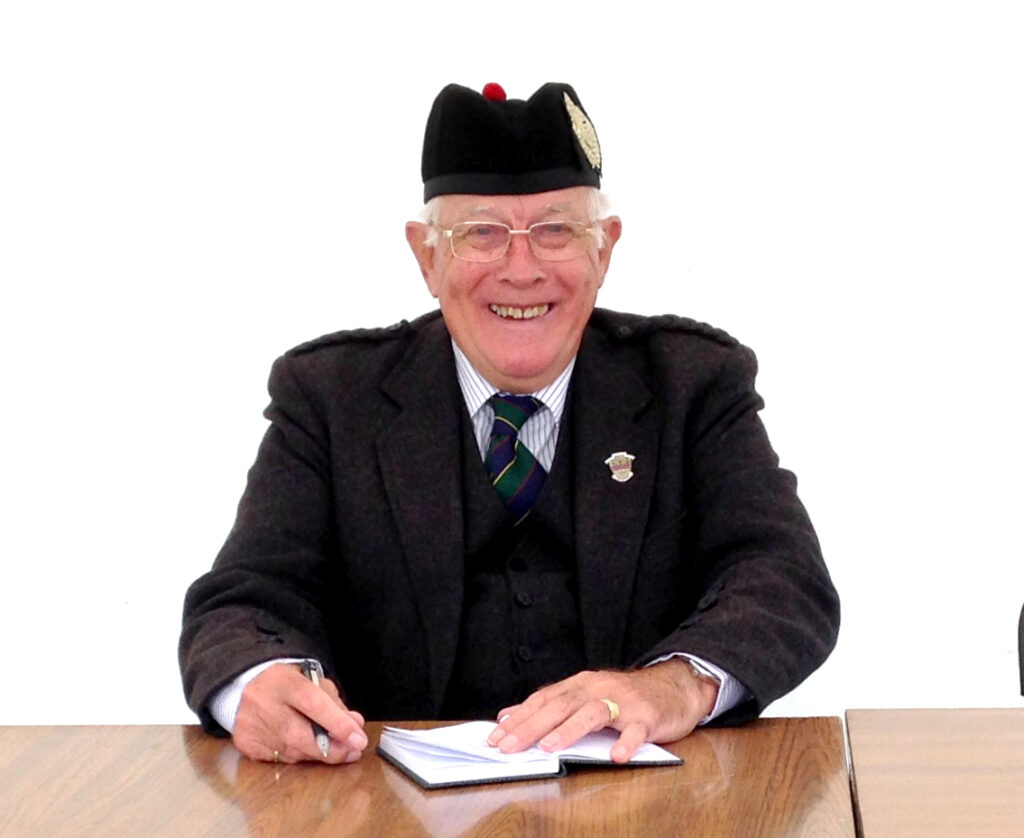
Ian McLellan, probably the greatest pipe major in the history of pipe bands, has passed away peacefully at his home in Bearsden near Glasgow. He was 88 and had been in indifferent health for several months.
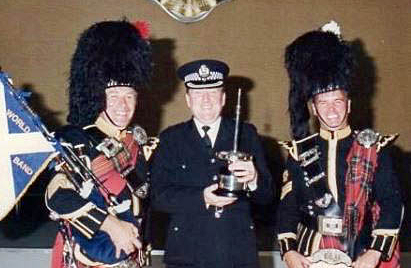
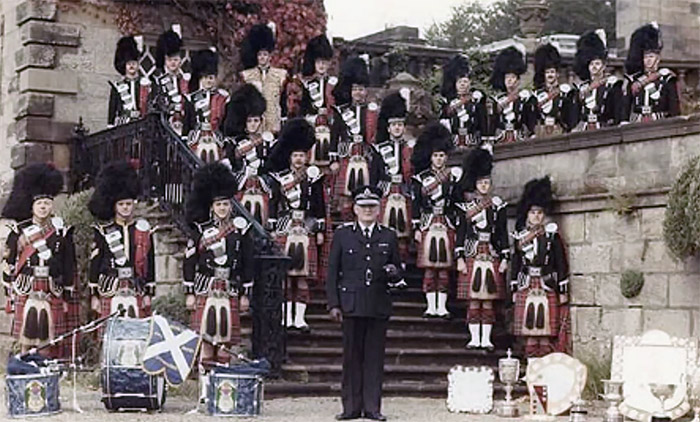
Ian led the Strathclyde Police Pipe Band to twelve Grade 1 World Championships, six of them in consecutive years. He secured his first title in 1976 and his last in 1991. He was also a champion solo piper winning most of the top awards for light music at Oban and Inverness.
His playing was characterised by solid technique and impeccable phrasing (he excelled at 2/4 marches) and everything had to be performed on a crisp, accurate instrument. This he drilled into his pipers, melding both accomplished and middle order players into Worlds winners.
In this he was aided by his leading drummer Alex Connel both graduates from the 214th Co. BB Pipe Band conveyor belt of excellence. Winning one Worlds is a huge achievement. Winning 12 with a motley crew of skilled and not so skilled players, all serving police officers, whipping them into shape by your own strength of personality and skill, takes P/M Ian McLellan to another level.
There was no piping in his immediate family, though his grandfather’s cousin was John MacLellan of Dunoon, the famous composer and piper. During WW2 Ian’s father Neill had the good fortune to work beside Alex Ibell and Joe King at the Dumbarton aircraft works building the Sunderland flying boat. Both Alex and Joe were tutors with the 214.
Ian’s family were bombed out of their home during the Clydebank Blitz and went to live at his father’s uncle’s farm at Shandon on Loch Long. They were there until 1947 and Alex Ibell, a keen cyclist, was a regular visitor, ostensibly to pick fruit for his wife’s jam making, but also to teach young Ian. ‘He arrived one day with a Logan’s tutor and a practice chanter for me. I was probably about nine at the time,’ said Ian.
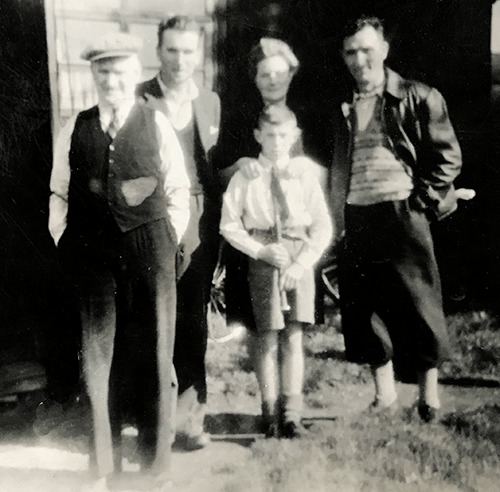
Ian received great encouragement from his father and when the family moved back to Clydebank he was able to attend Alex’s home in Whiteinch, further along the River Clyde towards Glasgow, for further lessons. He remembered: ‘I was a glutton for practice. I was always on the practice chanter. When I started working, I served my time as a toolmaker and I used to cycle home to Linnvale, Clydebank, at lunchtime every day, have something to eat, and then get on the chanter and cycle back to work.
‘The grounding I got in the 214 was, in my estimation, second to none. Technique was everything, and Alex Ibell may not have been the best piper in the world, but by God he could teach. He knew what was right and what was wrong and he emphasised that every movement had to be correct. I was a year on scales before he would let us near a tune and my first was Lord Lovat’s Lament, the first tune in the Logan’s Tutor. All the rudiments had to be off note perfect before you got near a tune.’
Ian joined the Boys Brigade when he was 12 and his tutors became P/M Alex MacIver and Joe King. He competed in BB solos but in the other amateur events didn’t do well. Of these days Ian said: ‘Obviously I wasn’t good enough, but you were coming up against boys like Kenny MacDonald and Iain MacFadyen who were steeped in it.
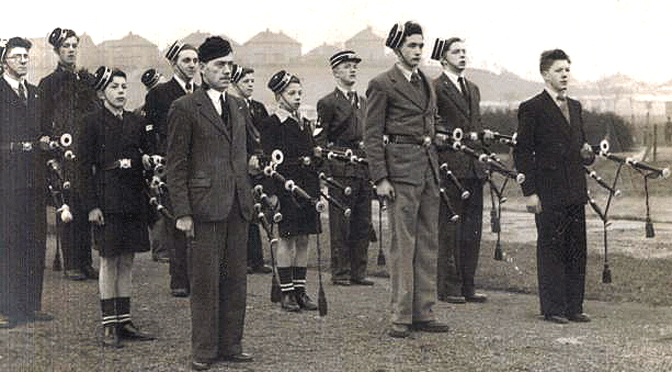
‘I was just a raw boy. I didn’t even have a kilt. I was lucky with pipes because the ones I have now, the coccus wood set, were bought from Joe King by my father and they cost £15. They had belonged to a man Willie Francie who had bought them in 1928 at MacRaes brand new. With the modern pitch I had to change the bass bottom. The first one I got from Bob Hardie and that made a huge difference. Then I got another from Sinclairs and that was even better.
‘I didn’t always play them in the solos because every now and then I could borrow Joe King’s pipes. In fact most of the big prizes I won at Oban and Inverness came when I was playing Joe’s pipes. They were a magnificent set.’
Ian enjoyed many successful years in the 214 band (winning major titles consistently including in the adult grades). He did National Service in the Argyll and Sutherland Highlanders under P/M Andrew Pitkeathly where he received further expert tuition. From the Army he joined the City of Glasgow Police where he came under the wing of P/M Ronald Lawrie. Ian impressed the pipe major to such an extent that he eventually became Pipe Sergeant of the band. Ronnie also encouraged Ian to compete in solo competition.
‘I never thought of myself as being an exceptionally great player, until Ronnie gave me the confidence,’ said Ian. ‘He told me I was as good as anyone out there. He said that one of the things I did have which a lot of the competitors didn’t, was a good bagpipe.’
‘Later, when I was setting up my own instrument for the solos big Ronnie taught me to be very conscious of note intervals in the chanter. If you don’t get these intervals right your drones are never going to stay steady all the way up the scale of the chanter. Well I said if that was the philosophy for solos it was my philosophy for setting up a band.’
When Ronnie retired in 1972 Ian took over the band and after four years they began to figure in the major prizelists. Police forces in Scotland at that time had undergone amalgamation and the City of Glasgow Police were joined with Lanarkshire Police and Renfrew and Bute Constabulary to form Strathclyde Police. The City of Glasgow band absorbed pipers and drummers from these forces, but only those who were serving police officers.
Of his solo career Ian recalls: ‘The first time I competed at Oban, 1965 I think, I won the Marches. I can always remember it. It was twice through, it was outside, it was bucketing down with rain and I was first on.
‘Eventually I went away and played in the Strathspey and Reel. Later on I was wandering round the park and I met Andrew Wright. Oh well done, he says, you’ve won the Marches. You could have knocked me down with a feather. I can always remember the tune I played. It was Brigadier Cheape. You don’t hear it often in the solos now.
‘Earlier that year I had won the March at the Uist and Barra with the same tune. The thing that always stuck in my mind was that big Ronnie Lawrie won the Uist and Barra playing the same tune the previous year. I think I modelled a lot of my playing on Ronnie. I felt the way he played marches was just out of this world. Another guy I loved listening to was Hector MacFadyen. Strong hands and beautiful bagpipe. His tunes just flowed.
‘Two years later I won the Oban Former Winners. I always remember that you got nothing to show for it, no trophy that your name could go on, no medal even though it was one of the most important prizes in piping. Just a £20 note that soon disappeared when I bought everyone a drink! It’s different now thankfully.
‘The first time I played at Inverness was in the late 60s. In either 1970 or ‘71 and I won the Marches with John Wilson second to me that day. I won it with the Highland Wedding. Hugh Kennedy was another of my favourites and the other was Major Manson at Clachantrushal. I won a lot of prizes playing that. If I look at competitions like the Eagle Pipers, Edinburgh Police, Uist and Barra and Scottish Pipers, the march that I was most successful with was Highland Wedding. In fact it got to the stage that I stopped putting it in.
‘I always liked a march to sound like a march. You hear some people playing and they are so much into the phrasing of the tune that they forget to keep it flowing. It happens in the big competitions. They are all out there playing their cards close to the chest; no mistakes. But I think I was the opposite. I used to say ‘to hell with it; I’m going for it; if something happens, so be it.’
- Read more about this great piper in our Famous Pipers column. Details of Ian’s funeral in due course. If any reader would like to leave a tribute or message of condolence, please do so in the our Comments section below.

RIP IAN A GREAT MAN
I still remember talking to Ian for the first time when I was a kid and the Strathclyde Police had a mini band doing a recital in the King’s Arm’s Hotel in Girvan back in the 80’s, inspirational. He said to me and my mate that if we practiced we could join the band (yes, I know), but it was a great encouragement to both of us.
Sorry to hear about Ian’s passing. Played in the 214 with him.
Condolences. May & Bob LAVERTY.
Very sad to hear the news of Ian’s passing. I had the great privilege of meeting him at the Pipe Major John McLellan DCM 150th anniversary Photo Exhibition at the Dunoon Burgh Hall in July. He will be really missed. My sincere condolences to all his family.
Yesterday was possibly one of the hardest days I’ve experienced after taking the call from John Wallace. Ian was simply the best. There are so many people that owe him so much and I most certainly am on that list. He was a fantastic man manager and knew how to get the best out of his band. I will never ever forget him.
RIP Pipe Major
Ian and I were very close friends for more years than I dare consider and I am devastated at his passing. Despite his outstanding record of Pipe Band Championship wins and his high profile as a solo competitor, judge and teacher, he remained a very modest and approachable man who had a passion for our music. I was privileged and honoured to act as his Pipe Sergeant during the halcyon days of our World Championship wins and these were experiences which I will never forget. My deepest condolences to Karen, Janice and their families. Ian, my friend, rest in peace.
Ian was such a true gentleman and an inspiration to so many. We had the privilege of him piping at our wedding in Dumfries many years ago. Sending heartfelt condolences to Janice, Karen and families.
Condolences to the family. Ian was a true gentleman, inspiration and piper,
RIP Ian.
John Recknagel
So sad to hear of Ian’s passing, a great Pipe Major, competitor, judge, and most of all gentleman.
I have had the privilege of knowing Ian since I was a young piper at the SPA club nights in the Dorchester Hotel in the early 1970’s.
In the past few years I have sat alongside Ian judging the London Medallion and had him as an adjudicator at the SPA professional competition. His wit and humour was as sharp as his playing.
I along with many others will miss him, but will never forget him, and through these memories Ian will live on.
My thoughts are with his family at this time.
Thankyou Robert for this very fitting tribute to my dad. He was indeed everything the comments are stating. A total inspirational lovely gentle man to all. In addition also an amazing dad to me and Janice.
The piping world has lost a true legend. My heartfelt condolences go out to Ian’s family and friends. Ian was a hero of mine in my early days as P/M, and much of what I achieved came from studying his approach. I will never forget standing close to Strathclyde Police Pipe Band, with the hairs on the back of my neck standing up.
A picture of Matt Wilson, Ian, and myself with the Worlds trophy has hung proudly in our house since 2022, and I will always treasure it.
Rest easy, P/M.
Richard Parkes
So sad to hear of the passing of Ian the greatest Pipe Major of all rest in peace Ian you will be reunited with May and Harry
Ian showed us all the right way to do things.
So many memories!
Terry Lee
A wonderful man and inspiring teacher.
Condolences Donald I never knew that
Simon
Sorry to hear this sad news Ian a true great I loved his visits to (NI) to judge the bands always fun times.
R.I.P. Pipe Major, your duty is done! You certainly inspired us all right enough, whether it was concentrating on solo or piping as a unit, working on the instrument itself, achieving strong, clean finger technique etc. or the musicality (letting it flow & bringing out the vitality … you had it all in abundance Ian! Rest easy Pipie, May God bless & keep you safe in his arms. Slainte Mhor. Pipe Major Gordon Walker.
Very sad news. Ian was such an inspiration to so many of us through the years. Condolences to all the family
A very sad day. I’m honoured to have played under Ian between 1981 and 1994. He had the ability to turn a “no bad player” into a world class bandsman. Condolences to the family.
A great man and a great loss
Oh so sad to see this. Ian was always such good company especially when he came with Joe Noble to judge in Malahide. He always had time for a chat and a story even when he was judging. The last time we saw him was at the Glenfiddich with Gordon McCready where we had a dram or 2.
The sincerest of condolences to Ians immediate family members at this saddest of times.
I was fortunate enough to have Ian as my tutor when I was a boy and have very fond memories of visiting him at his home for lessons. My father wanted me to be taught by the best and in his eyes, that was Ian. Not only was he my tutor but he was also a role model and good friend.
A great loss to the pipeband world.
With deepest sympathy,
Donald
So sad to hear news . He supported me for many years via the cops . They still do .
Will attend funeral to show respect .
Jim Begg