


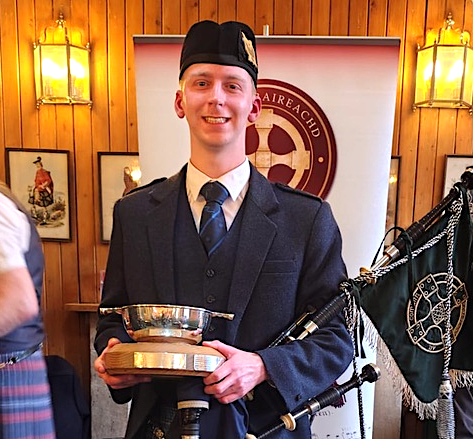
The winner of the 42nd Archie Kenneth Quaich competition was Andrew Robertson from Edinburgh playing the Lament for Donald of Laggan.
Andrew is pictured above with the winners’ trophy and banner. The competition is for amateur piobaireachd and is run by the Piobaireachd Society. It was held last Saturday, February 28, in the Royal Scottish Pipers’ Society Rooms in Edinburgh. It attracted an entry of 25.
Other prizes: 2 Tom Peterkin (Lament for MacSwan of Roaig) 3 Anthony Kelly (Tulloch Ard) 4 Stewart Allan (Melbank’s Salute) 5 Andrea Jones (Marquis of Argyll’s Salute). The judges were Derek Fraser and Darach Urquhart.

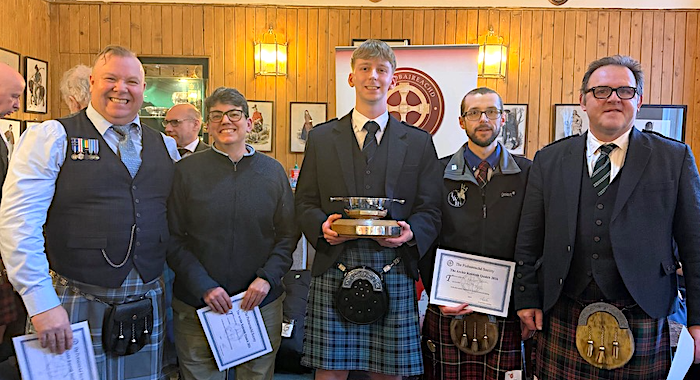
Organiser Peter McCalister reports: This was our 34th contest and for most of those years we have been the fortunate guests of the Royal Scottish Pipers Society (RSPS) in Edinburgh. Their acoustics, vintage photos, bar, and tuning rooms are second to none. We are deeply indebted to the Society for all their years of hospitality.
At the last minute there were several call-offs, so 21 pipers played. This was a pity as 32 had applied and a draw was done to see who could play. Those unsuccessful in this draw will get a ‘bye’ for next year, if numbers are once again too great.







The friendly ambience was palpable, with players travelling from various parts of Scotland, Ireland (Anthony Kelly) and our regular visitor from the USA (Andrea Jones).
I heard nearly everyone in the final tuning room where Colin MacNeill helped with some final set-up of the chanters and/or drones. Stewarding was done by Tom Lewin and Leslie Barrett – the latter had played earlier in the draw, and then nobly, put on the steward’s badge in the afternoon. A previous winner – Gill Cairns – turned up to have a listen and got drafted in to help with various wee jobs on the day … thanks, Gill.
Andrea Jones was not happy with her tune so got changed into civvies – and then was surprised and delighted with the prize when it came. This time she came from the USA alone, without her support team.
I missed Stewart Allan’s tune but he brought his support from Ayrshire; I note that he was fifth a few years ago so he is working his way up. Anthony Kelly from Ireland had possibly the best bagpipe of the day, certainly a big sound from the big guy, and his Tulloch Ard was a strong contender.
Edinburgh-based Eagle Piper Tom Peterkin gave one of his signature musical performances. A couple of tiny technical slips, and a questionable high G, may have stopped last year’s champ getting his seventh win.
By the way, a few more Eagles turned up to hear the afternoon performances including Iain Dewar, Allan Harper, Douglas Gardiner, Euan Anderson and Iain Speirs. The venerable James Burnett ascended the (many) stairs unaided aged 95, to add his gravitas to the occasion. Alan Forbes (Chairman of the PS Music Committee) was there for most of the day. I have probably missed out other audience members that deserve a mention, and by the end of the day the audience was considerable.
Andrew Robertson had not competed at a piobaireachd contest before but played a very musical and measured Donald of Laggan. The whole effect was a of a complete piece of music, and a tiny drift of the drones was not a distraction. Well done, Andrew.
After the contest Derek Fraser made a short speech, telling the competitors that they had put on a very enjoyable day for him and Darach. As last year, he advised pipers to look carefully at the tuning of the chanter scale – at times this led to an out-of-tune instrument which let a few pipers down. A second bit of advice was to keep plugging away at the practice chanter for the piobaireachd technique.
The Piobaireachd Society plans to hold this contest next year as usual – probably on the last Saturday in February 2027 – and welcomes amateur players and their supporters to come along once again.

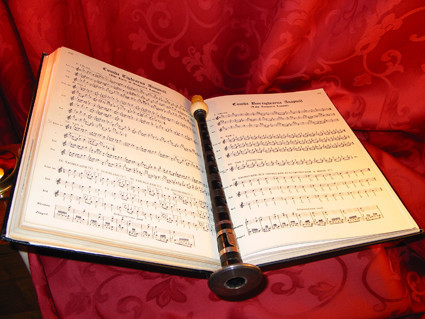
Classic Piobaireachd (Vol.2 L-M): Lessons on Great Tunes
Here we have more of the very best piobaireachd from the ceòl mòr canon. Every piper should know these tunes, or at least have a working knowledge of them. They are played here in full by Robert Wallace on the practice chanter without interruption. Thus he preserves the essential linking of the phrases and variations as they occur, making each tune a complete unit – exactly the way it should be presented – with no one part of the tune…