


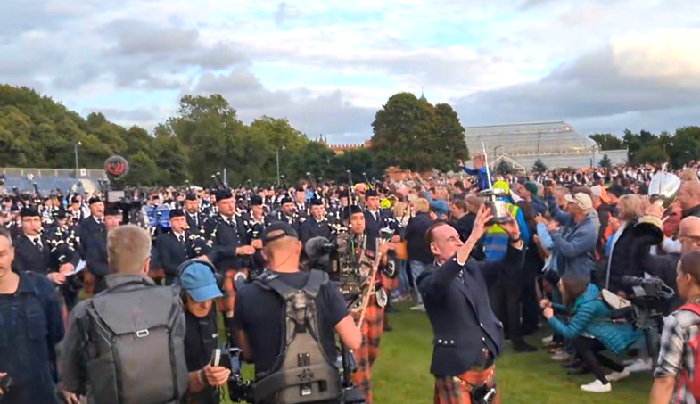
Unfortunately, I was able to attend only the Saturday of the World Pipe Band Championships this year. Unlike some of the previous years the weather was pleasantly warm, free from rain and with only a mild wind, so the atmosphere was ideal for tuning and for the band performances.
Both days were well attended by spectators (estimated at around 35,000 over the two days). The official programme showed a total of 211 entrant pipe bands. From the published results I made it that 205 bands actually competed over the two days, which was almost the same number as 2025. I also calculated that there were 55 pipe bands from 14 countries outwith the UK, two more than last year. It is obvious that the Championships are losing nothing of their appeal.


By Alistair Aitken OBE
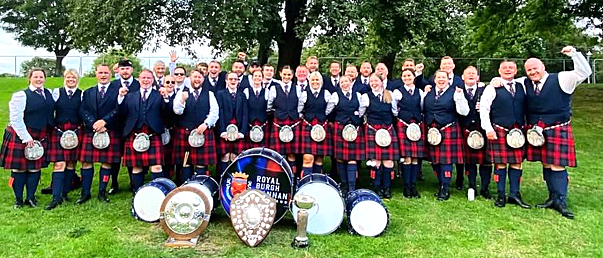
Hearty congratulations must go to the Grade 1 winners Simon Fraser University from Canada under P/M Alan Bevan and L/D Reid Maxwell (originally from Fife). This is the first time the band has won the World Championships since 2009, having achieved the accolade six times previously under P/M Terry Lee. The last time a band outwith the UK won the Championships was 2010, when the winners were St Laurence O’Toole from the Republic of Ireland.
The Grade 1 competition required bands to play four times over two days, involved 16 different adjudicators and, as the results showed, it was a very closely fought competition.
Congratulations must of course also go to the winners and highly placed bands in all the other grades. For many a high placing at the Worlds will be the pinnacle of their pipe band careers and well worth the substantial effort and commitment to get there. It was also pleasing to see the high numbers of bands in the Juvenile and Novice Juvenile grades, illustrating the interest in piping and drumming among the young and laying a solid foundation for the future. In fact everyone who competed deserves congratulation.

The only competition I was able to listen to fully and seriously was the Grade 1 March, Strathspey and Reel on Saturday, and this from a position in Section C of the main stand. From there I could hear slightly more of the volume of the drumming than from my preferred position facing the head of the competition circle.
Overall, I thought it was a very high standard competition and the results were very consistent across the four adjudicators. My personal thoughts from where I was sitting (which I accept mean absolutely nothing) were:
Best overall band performance: Simon Fraser University or Field Marshal Montgomery
Most fluent, rhythmic and musical presentation: Inveraray and District
Best band tonal balance: Boghall & Bathgate (sweet pipes, well-balanced drums)
Best drum corps: St Laurence O’Toole or Simon Fraser University
Best Bass Drum sound: St Laurence O’Toole
Alex Duthart drumming influence: St Thomas Alumni
Worthy of a higher placing: Police Scotland Fife
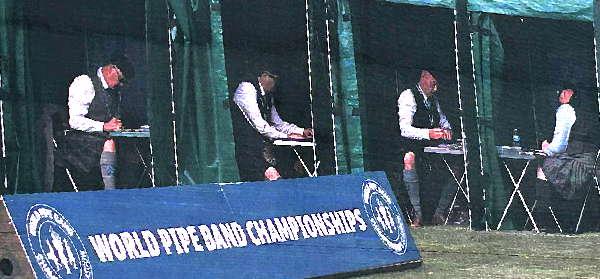
While sitting in the stand I also made a number of observations: The adjudicator tents had been moved to the opposite side of the main arena where there are no spectators. I presume the aims of the change were two-fold – to improve the viewing for standing spectators and to allow the adjudicators to be closer together now that they are allowed to confer.
The downside of this change was that the adjudicators had to walk greater distances to and from their tent between performances, reducing the already limited time they have to complete writing and finalising their critique sheets.
I can recall previous complaints about that; the introduction of two piping adjudicators to achieve a balance of views rather than the same results; a major furore about positioning the tents so that the adjudicators could not confer; and a similar one when the previous consultation system was cancelled due to concerns about dominant individuals influencing alterations in results, and some refusing to participate. How things change!

One thing that has not changed is the annoying humming noise from compressors which is continuous behind the spectator stand and affects spectator listening. It is just as well that the adjudicators were not in their tents during the band performances.
On a possibly more contentious subject, I am not a fan of the Ensemble adjudicator walking around the circle performances. Ensemble adjudication involves an assessment of collective band tonal balance, integration, musical interpretation and overall effect, and any major defects in piping and drumming technical delivery.
In my view it is very difficult to assess the tonal balance and these other aspects when walking round the competing circle. The sound projection continually changes as you progress round (including being affected by differing drum corps player positioning). By the time you reach the rear of the drum corps you are hearing a completely different sound projection with the pipes coming through the drums. My preferred Ensemble position is around the head of the band where you can hear the drums coming through the pipes in a consistent way.
As I have often argued in the past, I would also still like to see at least a trial with all four adjudicators on a raised platform close to the front of the competing circle so that they are all hearing the performances in the same way. I noticed that this year the BBC had 11 microphones recording simultaneously around the circle. None of the adjudicators can possibly hear the performances in that way in their different positions.
In summary, I fully enjoyed my day and the high standards being achieved. All those involved in organising the Championships have to be congratulated for another successful event which I am well aware is a substantial organisational challenge.
I have just been reading Iain Duncan’s excellent recent publication ‘Around the Worlds’ which documents the history of the Championship in great detail. It made me realise that I have now been attending since the mid-1960s, either as a competitor, adjudicator or spectator.

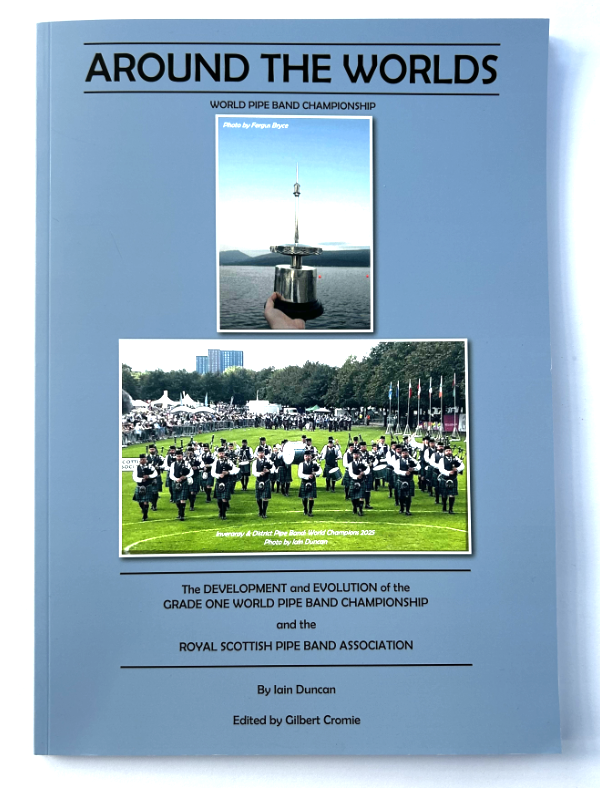
Above all, the publication illustrates how far the RSPBA has developed since it was formed in 1930 as the SPBA, despite the many trials, troubles, problems and criticisms encountered over the years since that time. Allowing for missing the two pandemic years, this was the 77th World Pipe Band Championships since the SPBA assumed responsibility for the event in 1947. Long may it continue.
A superb digital book of pipe music….

Click on pic to order…..