

The problem of pupils being judged by teachers in piping competitions has caused much debate and division. For the past few years I have spent quite a bit of time using experiences from judging along with playing, and have formulated a plan which I believe solves these problems.
By Colin MacLellan
In reality, it is very simple, but perhaps appears less so when committed to paper, because every circumstance must be accounted for. On speaking with several judges, competition organisers and competitors it has been received very favourably.
The plan does need to be read and understood carefully. I sent it to the Solo Piping Judges Association in October 2024, and later to the Competing Pipers Association.
I do not believe that it has been circulated to the members of either organisation to date. I would like all pipers and judges to be able to see it and make up their own minds.
The proposal certainly provides a much better situation than the one that we face just now, that of Senior Judges stopping teaching because they would rather judge, and of the prospect of new, very expert pipers not being able to judge at all in the future – not to mention the considerable problems competition organisers now face in obtaining judges.
I would like to stress for clarity that the proposal first and foremost works because it DOES NOT allow teachers to judge their pupils, but it does allow them to judge any competition whether they have pupils in it or not.
Here is the proposal and I leave it entirely to all competing pipers and to all judges to make up their own minds as to its merits and usefulness:







Judges’ Guidance:
- A discussion shall take place immediately at the end of the competition in order to determine if major errors have been noted or have not been noticed – at that point judges are free to adjust ranking dependent on the outcome of the short discussion.
- Judges shall rank each competitor in order of preference (ie) 1,2,3,4 etc down to 8.
- The lowest score average aggregate amongst the three judges shall be ranked highest.
- If a judge has a conflict with a pupil playing, then that judge shall not rank that player and the average ranking of the other judges shall determine the player’s ranking.
- The completed ranking grid must be handed to the competition organiser at the conclusion of each competition. It will be retained by the competition organiser for a period of time as an accurate record of the competition result.
Points of Interest:
- The grid (see below) to be filled in will be provided to the judges at competitions.
- The simple system allows teachers to judge competitions in which they have pupils playing without fear of bias or other perceptions.
- The system thus allows a significantly greater number of judges to be eligible to judge than is the case at present.
- The system allows for different opinions to be taken into consideration in a completely equitable way.
- The system completely negates the possibility of dominant voices on a judge’s bench having too much influence on the result of the competition in question.
- Most importantly, the system allows for a completely unbiased, proportional, and accurate blending of the opinions and views of the three judges. It will also end the very contentious controversies over teachers judging pupils.
Sample competition to demonstrate: The three judges are Willie Ross, John Macdonald, and GS McLennan. Ross teaches Drummond, Macdonald teaches McCallum, and McLennan teaches Johnston.
Ross’s rankings:
1 Beaumont
2 McCallum
3 MacLeod
4 Johnston
5 Midgley
6 Urquhart
7 Speirs
8 Sinclair
Drummond not ranked
Macdonald’s rankings:
1 MacLeod
2 Johnston
3 Midgley
4 Drummond
5 Speirs
6 Beaumont
7 Sinclair
8 Midgley
McCallum not ranked
McLennan’s rankings:
1 MacLeod
2 Speirs
3 McCallum
4 Midgley
5 Sinclair
6 Beaumont
7 Urquhart
8 Drummond
Johnston not ranked
They declare their interest in the pupils they teach to one another before the competition begins, and they do not give their pupils a rank when determining ranks 1 to 8. Any player not in the top eight from any given judge is given a score of 10 for that judge.
Scoring Grid

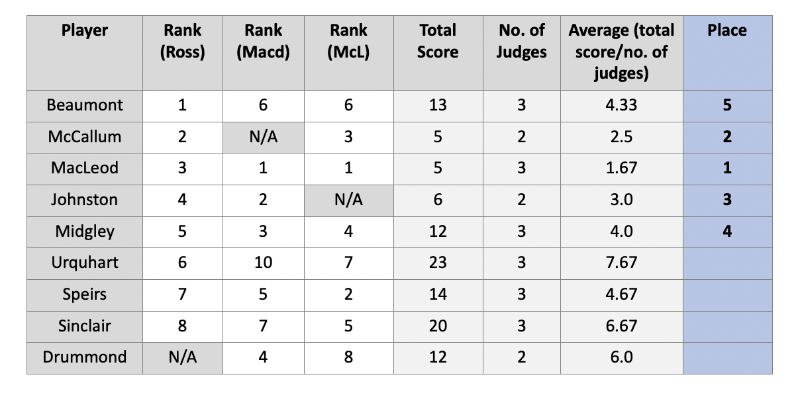
In the event of equal scores, the judges should discuss and agree on the final placing between those two players.
FAQs
Why is this new plan needed? What’s wrong with what we currently have? The plan is needed because the present restrictions on judges judging pupils constrict the availability of many judges. A return to little or no regulation would reintroduce significant concerns regarding conflicts of interest. This new plan will resolve these issues, allowing all judges to be able to judge any events without real of perceived conflicts of interest, without being restricted in their teaching activities.
Won’t it be too complicated? Judges will be provided with a simple blank grid in order to record their rankings. The final score is just the average of the rankings divided by 3, or where there is a pupil playing, 2. The final scores then just need to be put in order to determine the result. It will be important to carefully check that all rankings have been recorded accurately.
Under this plan, is it now acceptable for me to judge any event in which my pupil may be playing, including the major competitions? Yes. The intention is that this plan provides a fair format for everyone to be able to judge any competition.
Isn’t it preferable for judges to be able to discuss performances as a competition progresses? This plan allows everyone to fairly judge all competitions, and all pipers to be able to play. It avoids dominant voices taking precedence – discussion is allowed at the end of the competition in order to note major errors and omissions.
What if a player makes a major error and one or more judges don’t realise? These points can easily be noted and discussed at the end of the competition to ensure all judges are aware of major errors when determining their rankings.
Is this new system foolproof? Yes. It has been very carefully thought out over a long period of time and has been tested under numerous real – life and simulated competition scenarios.
Won’t people still think that it’s wrong for judges to be on a bench when they have pupils playing? The plan would be well communicated to pipers, competition organisers and piping media prior to use. Organisations like SPJA cannot control what people think, but this plan provides a satisfactory platform for alleviating the problems which are currently faced.
- Piping Press believes the writer deserves considerable credit for this proposal and would be very interested in opinions from readers. Please use the Comments field below.