

We conclude our look at the history of the pipe band movement….

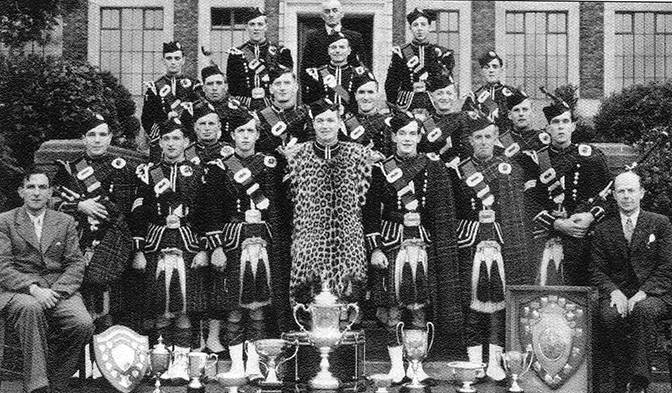
In 1947 the Association decided to take the World Championship away from Cowal. They had had a good offer from Edinburgh City Council who wanted it to be held there to coincide with the new international arts festival.
Cowal refused to give up the championship or hand over the trophies. The dispute was long and bitter and involved a lot of meetings and arguments and a great deal of newspaper coverage.
The upshot was that two World Championships were held in 1947, one at Cowal where the Glasgow Police were the winners, and the other in Edinburgh, won by Bowhill Colliery. Both contests were reported in the press.
The Glasgow Herald announced that the Glasgow Police had won the World’s Championship for the sixth time. They were one of nine bands who defied an SPBA ban on the Cowal contest.
The report also mentioned that in the previous year 44 bands had played at Dunoon but the prize money of £360 had remained the same despite there being only nine bands. The SPBA contest in Edinburgh had an entry of 85 bands.






Bands that played at Cowal were expelled from the SPBA and were not allowed to take part in any Association contests. Eventually the situation was resolved with the Cowal contest continuing as a major Championship and the Association running their World Championship in various locations.
From 1951 onwards judges were under cover and awarded points for intro, tone, breaks, and execution, with comments to justify points deducted. The scoresheet was taken away from adjudicators before the next band came on.
By 1955 Cowal toughened up its requirements for their championship. Grade 1 bands had to submit three sets of March, Strathspey and Reel, and the lower grades one set.
In 1956 the World Championships were held in Belfast, this being the first occasion on which the championships were held outwith Scotland.
A new points system was introduced in 1961 and in 1962 the idea of a possible fourth grade to replace the Ladies’ and Juvenile grades was broached.
The question of whether judges should be under cover or in the open was being discussed at this time, and in 1963 it was decided that they should be in the open.
Grade Four contests began in 1963. The bands in this new grade were to play either a two-part march twice over or a four part march once and have a minimum of six pipers, two sides and a bass drum. Other grades continued to play a march, strathspey and reel.
The usual judging set up was one for piping and one for drumming. Ensemble judges began to appear from about 1967 onwards. In 1968 there was an additional Novice Juveniles grade and at the 1971 SPBA AGM it was decided that there would be Grades 1 to 4, Juvenile, and Novice Juvenile al all championships.

Medley selections had been tried out and were now introduced for some contests. The traditional competition type MSRs continued, but many new tunes began to appear in the medley selections.
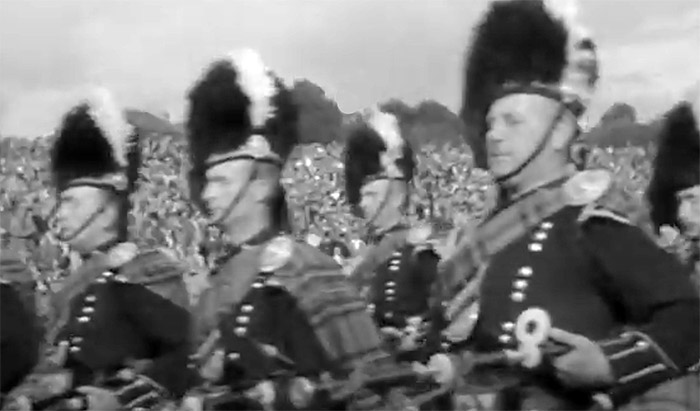
Another change at this time was the introduction of the simpler dress for competition. In the 1970s the top bands competed in full No1 dress, with spats, hose tops, doublets, plaids, cross belts and feather bonnets. This looked impressive but was uncomfortable, especially on a hot day. By the 1980s bands were permitted to dress for comfort, wearing black jackets, white socks and glengarries.
Since 1980 there have been many changes to the instruments of the pipe band. Plastic chanters are used and synthetic bags and drone reeds are common along with various systems of moisture control.
The drums too have changed with different tensioning and tuning mechanisms. The number of snare drummers in relation to the number of pipers has increased and so too has the number of tenor drummers, who now play drums in different pitches.
During the 1980s and 1990s there were various other changes to the format of the major competitions, such as qualifying sections and finals, seeding at major championships, and consultative adjudication.

Stewards now use walkie-talkies and compilers use laptop computers. Results are available on the web almost instantaneously with the announcements on the field.
The last major change to the grading system came in 1998 when Grades 3 and 4 were split into A and B sections, making in effect two extra grades.
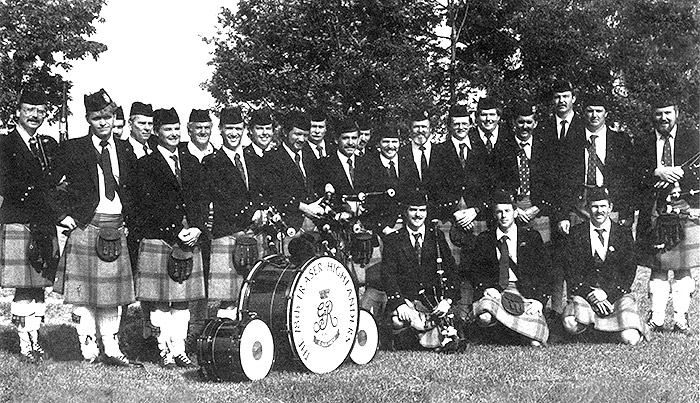
During these years pipe band competition became truly international, with many bands from overseas competing. 1987 was another landmark, with the first World Championship win by an overseas band, the 78th Fraser Highlanders. Since then the Worlds title has gone to Australia, Canada, and Northern Ireland many times.
Another feature of the modern day worldwide pipe band culture is the co-operation and discussions, which now take place between the various pipe band associations around the world.

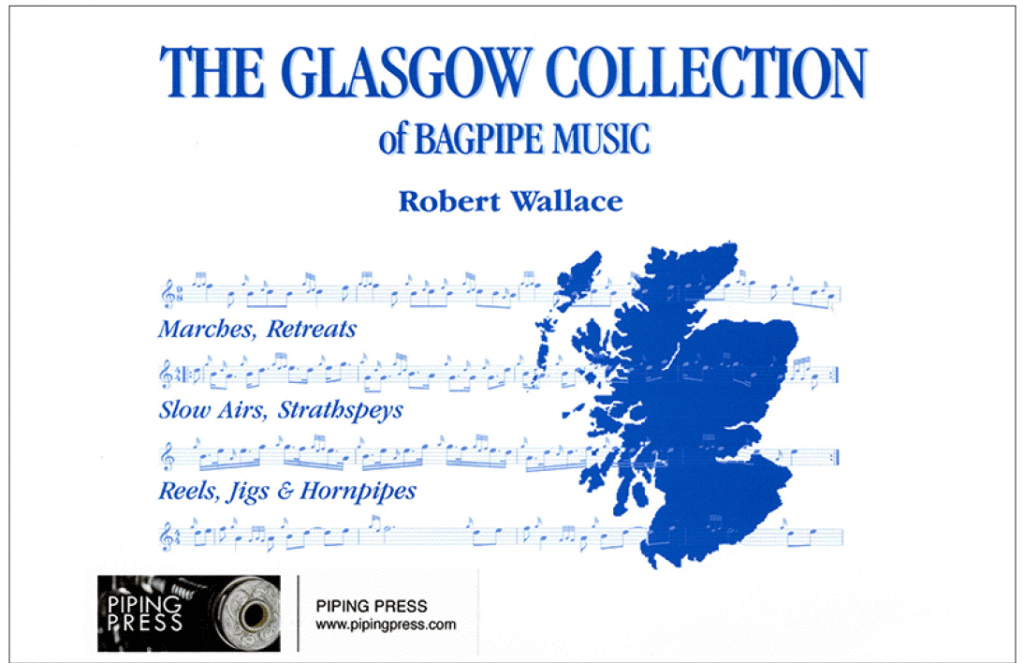
The Glasgow Collection of Bagpipe Music
Now in its fifth reprint, this book of ceol beag first appeared in 1986. Tunes are: Mrs John MacColl, James MacMillan of Victoria – British Columbia, William MacDonald – Benbecula, Men of Argyll, Detroit Highlanders, Dumgoyne, Peat Harvest, Captain Grant, Braemar ‘Wali’, A Parting Glass, Ancient Clan March, Kitty Lie Over, MacDonald of the Isles, Battle of Sheriffmuir, Wellfield, Dunaskin Glen, Wallace’s Farewell to Kuratau, Farewell to Muirheads, Loudon’s Bonnie Woods and Braes (air), Achmore Loch, My Brown Haired Girl,…