


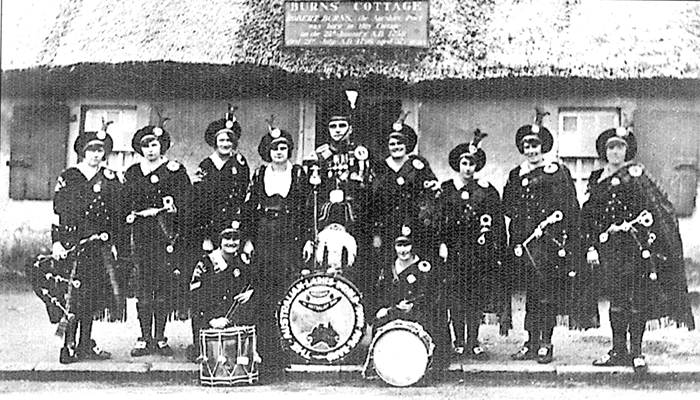
TIn January 1918, the South and Port Melbourne Thistle Society announced that women would be enrolled in its pipe band. This society’s male band was no weak or novelty outfit. It was a champion band. But the war had depleted its ranks. The Weekly Times reported:
‘It is announced that 20 young women have joined the pipe band of the South and Port Melbourne Thistle Society.’
By Stephen Matthews, Chairman of Pipe Bands Victoria
The usual newspaper jibe was there, of course, about ‘bonnie lassies’ and whether women should play pipes at all. But the fact remains that a serious Scottish society invited women in because the band’s public function had to continue.
Mrs Jessie Young became the central figure. The Age called her the ‘Pioneer Lady Piper’ and reported that she had taken a position in the men’s pipe band. Her husband had been killed in the war. Soon Jessie Young and Miss Annie Beaton were leading the society’s male band in public procession.
This was not novelty. It was wartime service, public music and Scottish-Australian respectability combined.






By May 1918, the female section of the South and Port Melbourne Thistle band (SPMT) was in Bendigo for a Red Cross carnival, under P/M Mrs Jessie Young and headed by Drum-Major William Darwin. The Bendigo report named the performers and noted that the South and Port Melbourne male band had been champion band of the Commonwealth for seven years.
Darwin is a significant linking figure. He appears here in the SPMT ladies’ story, and later in Australian pipe band history as organiser and leader of an Australian Pipe Band Tour in the 1950s and as organiser of the 1946 Australian Championship for the Sir Robertson MacPherson Memorial Cup.
The SPMT band quickly became a proper institution: officers, rules, finances, pipes purchased, public engagements, competition ambitions and annual meetings. It travelled, played carnivals, raised money, supported Highland dancing and appeared before civic and vice-regal audiences.
The tradition has not disappeared. South and Port Melbourne survives today through the City of Melbourne Highland Pipe Band, one of Australia’s oldest bands and a living descendant of that extraordinary Scottish-Australian pipe band world. Today it boasts a female president and a large proportion of female players across all three of its three competition bands in Grades 2, 4A and 4B.
Then came the Australian Ladies Pipe Band and its 1925-27 world tour, recovered in detail by Robert Campbell in Piping Press. The touring party included Pipe-Major Dolly MacPherson (who later married William Darwin), Pipe-Sergeant Klair Buchanan, pipers Gertie Oliver, Flora Ash, Mary Jack, Tilly Wyatt and Rosa Lee, Drum-Sergeant Florrie Yates, Drum-Corporal Laura Bate and drummer Molly Innes. Piper Gertie Oliver, from Ballarat, later married Lew Zillies, long-time drum major of the Ballarat Caledonian Society Pipe Band and later Ballarat Highland. He was also one of the key founding figures of the VHPBA.
The Australian Ladies were more than the first spark. They were the flame carried abroad. Their example almost certainly mattered. The Vancouver Ladies formed in 1927, soon after the Australians had been seen overseas and at places such as Cowal. Direct proof of influence may be hard to pin down, but the timing is suggestive.
Erin Grant’s 2016 work is useful here. She studied ladies’ pipe bands across Scotland and the diaspora, including Australia, Canada, England and New Zealand, and showed how they were connected to Scottish culture, identity and links back to Scotland. Australian evidence pushes the chronology earlier and gives it a sharper local cause.
Like elsewhere, ladies’ pipe bands later sprang up around Victoria from the 1930s to the 1950s with the lingering separatism from male bands. By the 1980s, as for elsewhere in the world, shifting cultural factors saw many ladies bands either cease or amalgamate with male bands, creating the mixed pipe band world we now take for granted.
So why Victoria? Because the conditions were there: early Scottish societies, pastoral wealth, family leadership, Highland gatherings, early contests, public patronage, war need and practical civic culture and in Victoria the pipes belonged not only to military tradition. They belonged to towns, families, societies, fundraisers, contests and public life.
This is the unacknowledged history. The ladies’ pipe band story did not wait for permission or guidance from Scotland. In a very real sense, it began where Scottishness had travelled, adapted and become local. It began in Victoria.
- Read the first instalment of this history here.
Ceòl Beag Lessons…. strathspeys, reels, hornpipes & jigs

Click on pic to select your tunes