


The story of ladies’ pipe bands is usually told from Scotland outwards, Scotland first, then the diaspora scattered around the Commonwealth. That is understandable, but it is also incomplete.
If we are looking for the early history of women in pipe bands, the trail does not begin neatly in Scotland in the 1930s. It leads to Victoria, Australia, and especially to the Western District: and cities and towns such as Geelong, Ballarat, Maryborough, Camperdown, Warrnambool and the towns around them.
By Stephen Matthews, Chairman of Pipe Bands Victoria
This was not an accidental setting. From the 1850s, Scottish, Highland and Caledonian societies grew strongly across Victoria. They were serious local institutions rather than isolated ethnic curiosities, often led by men of money, land and public influence.
The pastoral world of early Victoria was very Scottish: in 1848, about two-thirds of Port Phillip squatting licence holders were Scots, and in the Western District about two-thirds of the squatters were from Scotland. [Wikipedia: In 19th century Australia, a squatter was a settler who occupied a large tract of aboriginal land in order to graze livestock. At first this was done illegally, later under licence from the Crown.]
These men and families had the money and motivation to support music, the standing to fill halls, and the public authority to make Scottish culture visible.
Victoria became a place of Scottish pipe band ‘firsts’. Ballarat’s South Street National Eisteddfod of Australasia held its first pipe band competition in 1906, effectively the de facto Australian championship until the mid-1920s.
Maryborough had even scheduled a pipe band contest in 1900 following the existing brass band model, although it was cancelled because only one of the few bands then in existence entered. These dates are remarkably early, even beside the development of formal pipe band contesting in Scotland itself.
Then came the Victorian Highland Pipe Band Association in 1924, the oldest pipe band association in the world. Its founding was connected to Western Victoria, to Geelong, and Ballarat.








Even the survival pattern of bands from that time to this day is striking. In a current working list of 23 still-existing military, police and civilian pipe-band lineages, 12 are Australian, 52.2 per cent. Scotland accounts for five, or 21.7 per cent, while England, New Zealand, South Africa, Canada, Ireland and the United States each account for one. Of the 12 Australian lineages, six are from Victoria alone. New South Wales and Queensland have two each; South Australia and Western Australia one each.
While this does not prove a final global conclusion, it does suggest that Australia, and Victoria in particular, has provided unusually stable conditions for the long-term survival of early pipe-band organisations. Caledonian societies, volunteer military units, local government, family patronage and town culture mattered.
Victoria was a place that built its own pipe band culture, rather than being a remote outpost waiting for instructions. And women were already inside it.
In 1907, The Australasian reported a ‘revival of Scottish sentiment’ in the Western District and named new or forming bands in Geelong, Camperdown, Warrnambool, Hamilton and Noorat. Then came the remarkable sentence: ‘Another interesting fact is that ladies are joining the pipe bands…’
The article named two young women in the Camperdown Pipe Band: Miss Lena Macdonald, daughter of Donald Macdonald, chief of the Camperdown Caledonian Society, and Miss Jessie Horne, daughter of John Horne, the society’s secretary.

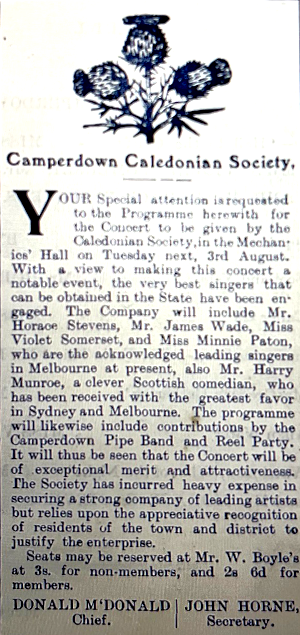
This is the key to the whole story. These women were not outsiders. They were daughters of the people who led the local Scottish society. They entered through family, society and civic legitimacy.
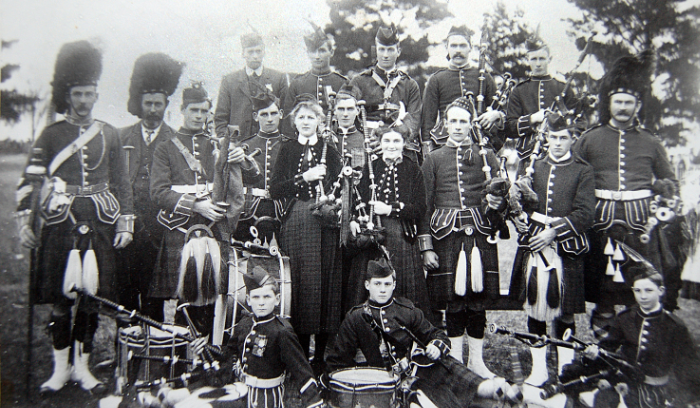
The photograph [top] of the Camperdown Pipe Band from 1907 proves the point. There, among the male pipers and drummers, stand two female pipers in distinctive tunic and long tartan skirts, not the military-style uniforms of the males.
The picture is reproduced here with the permission of the Camperdown Historical Society. The names attached to the image and to the newspaper record make it one of the most important known photographs in the history of women in pipe bands.
This helps explain why the breakthrough could happen in Australia. Scotland had the tradition, but also the weight of tradition. Pipe bands were strongly male, military and conservative. Victoria had something different: Scottishness remade as local civic culture. It was practical, public, family-based and less bound by homeland cultural restrictions.
Then came the Great War.
- To be continued.
Ceòl Beag Lessons…. strathspeys, reels, hornpipes & jigs

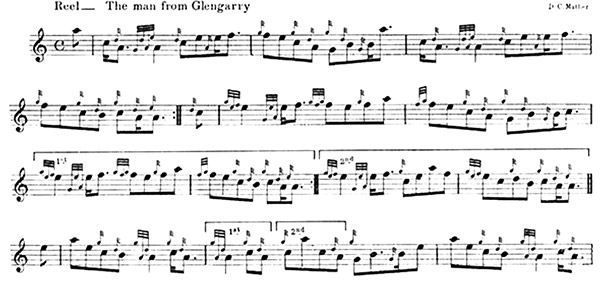
Click on pic to select your tunes