

The writer continues his response to last week’s article by Alan Jones on pipe band adjudication and the judging of ensemble…


The role of the ensemble adjudicator undoubtedly should embrace primarily the tonal balance, integration and combined musical interpretation to a much greater extent than say the piping or drumming judge.
He/she should focus less on technical issues – but should not ignore any technical aspects of significance.
There can also be variations in drumming and ensemble assessments as the overall sound projection of a band can vary according to where the adjudicators position themselves. As I have argued before I would like to see all of them in the same (ideally raised) position where they can hear the same sound projection.


By Alistair Aitken OBE
I would also argue that both drumming and ensemble adjudicators should be taking into account the effect of the bass section. This is often referred to as the ‘mid-section’ these days and I recognise without any doubt that there have been major advances in recent years in terms of numbers and variety of tenor drummers.
For me, however, bass and tenors are an integral part of the drum corps and should be assessed as such. Many critiques probably only make fleeting references to their musical effect (and for that matter to the artistic aspects of the flourishing).
A ‘pipe band’ has always consisted of pipers and drummers and there has never been any obvious need for a bridging section between them. That is a key role for the bass drummer.






I am not sure either that I fully agree with Alan Jones that MSRs are essentially standardised, although I understand what he means. Much depends on the selection of tunes. In 2006 the RSPBA introduced a Musical Appreciation and Presentation (MAP) contest format for Grade 4 and Novice Juvenile.
It was successful in encouraging musical effects from the drummers from a selected number of 2/4 marches. Strathspeys could be portrayed in a stately or lively, rhythmic manner; similarly reels could be presented with excitement, dynamics and energy.
Pipe band medleys have developed tremendously since they were introduced in 1970, many at that time constructed around jigs and hornpipes.
Pipe Majors and Leading Drummers nowadays are very adept and skilful in configuring traditional tunes in innovative ways to great musical effect and without losing the melody.
Others seem to prefer to focus on finger and drumstick dexterity with less melodic impact, which arguably at times stretches the boundaries of normal pipe band music.
It is fact, however, that music affects the emotions of individuals (including adjudicators) in different ways, so there will always be assessment differences.

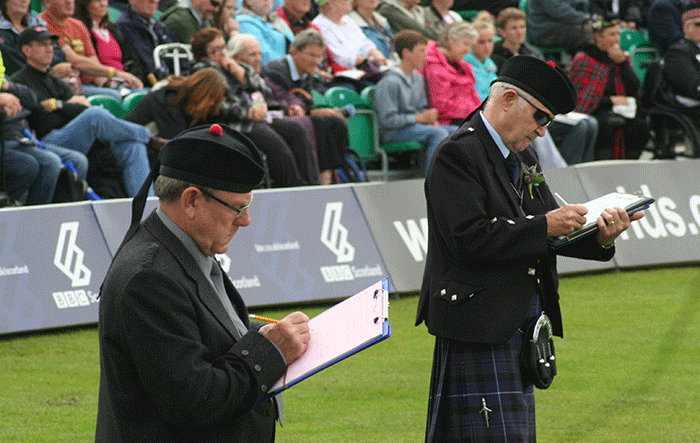
It also seems to me that there are similar issues with solo drumming competitions. As far as I am aware the RSPBA Music Board has never defined the factors which should be considered by those who judge these competitions.
In my experience the main focus always seems to be on the degree of difficulty of the drum scores and the technical proficiency of the playing.
‘Solo drumming….If it is not a musical contest why bother with a piper or pipers?‘
For me other important factors are the interpretation of the melodies, integration with the piper/s and whether the pipes and drum balance in pitch and weight. If it is not a musical contest why bother with a piper or pipers?
I am fully conscious that my comments in these articles may not be shared by others and also that views may have moved on since my time in the RSPBA. I am sure the debate will continue for many years to come.
Perhaps in conclusion I should repeat the words of Drum Major Alex D Hamilton, one of the pioneers of pipe band ensemble during the 1960s. They pretty much make the case for it and at the same time provide food for thought. His advice at that time was:
‘In dealing with the combination of pipes and drums, I prefer to use the word ensemble because I think it describes best what we mean by both sections of a band taken together for musical effect; but, call it what you may, my chief concern is that we understand the subject under discussion.
‘It is fortunate that we have a number of enthusiasts amongst us keen on a better musical combination but, on the other hand, we still have a very large proportion who might become a little more enlightened if they could be made to take a little interest in the combined effect of a pipe band and not look on the band either from a piping or drumming point of view.‘
- Read part one of Alistair’s article here.

John MacKenzie’s Collection – digital book
First published in 1973, this outstanding collection is re-issued here in digital format with kind permission of the late Pipe Major’s family. The book runs to more than 50 pages. It is offered at a nominal price to cover overheads. It contains outstanding melodies such as the 6/8s Tug Argan Gap and MacNeills of Ugadale, the Wedding Waltz, Neuve Chappelle, Joe McGann’s Fiddle, the Saffron Kilt, He-Ro-Hirum and many others. Please note this is a digital download book set for tablet…