



The recent article by Alan Jones regarding pipe band adjudication and the judging of ensemble, sparked my interest in view of my former role as a drumming and ensemble adjudicator and my involvement for almost 20 years in RSPBA adjudicator training.


By Alistair Aitken OBE
The whole subject of ensemble in particular has been a somewhat contentious one since the concept was first raised well over 60 years ago. Even when it was formally introduced in 1970 by the then SPBA for medley competitions at major championships, it was controversial.
The first ensemble adjudicators were prominent and respected individuals from other musical disciplines but that did not sit well with the pipe band community itself.
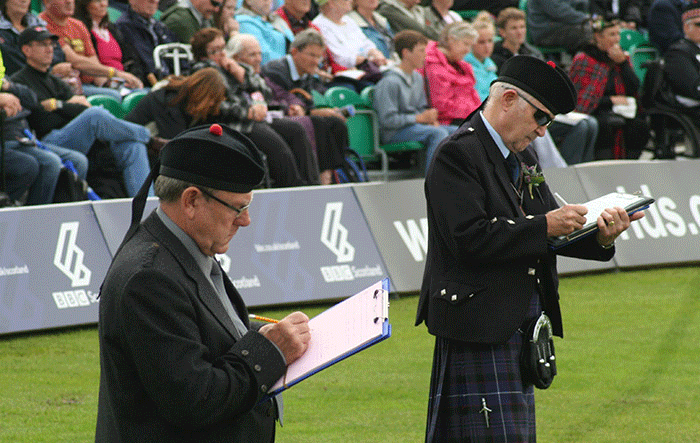
Shortly thereafter ensemble adjudication became the domain of (mostly former) competing pipers and drummers and has remained that way ever since whilst also retaining the separate roles of piping and drumming adjudicator.






Over the years the debate has continued with differing interpretations and it has also often been argued that adjudication of pipe bands should be undertaken by a single category of ‘pipe band’ or ‘ensemble’ adjudicator similar to what happens in brass bands, orchestral music etc.
In reality there are good arguments either way, but the pipe band community has allowed the three distinct types of adjudicator to survive, albeit that they might have their faults.
Many of the issues identified by Alan Jones have been identified and debated before. I find it difficult to agree, however, with his view that piping adjudicators should ignore the drumming and the drumming adjudicator should ignore the piping. Ensemble, as defined in the RSPBA Structured Learning Book 3, states:

‘Ensemble is the coming together of the component parts to establish a complete entity. A ‘good ensemble’ is the combination of well-matched and balanced components that successfully produce a pleasing (harmonious) effect.‘
In considering this definition in the context of RSPBA adjudicator training during my time, we concluded that there could be a contradiction and potential confusion with the actual term ‘pipe band ensemble’. A pipe band can simply be defined as a musical ensemble (i.e. a group of instrumentalists playing together and in harmony).
However, pipe band ensemble as we know it, is different. It is a process which represents different aspects of the effect of the instrumentalists playing together. A more understandable description might have been ‘pipe band orchestration’.
‘I find it difficult to agree, however, with his view that piping adjudicators should ignore the drumming….’
When delivering adjudicator training we considered it important that, as the focus was on collective performance, all three adjudicator disciplines should be making their judgements in that context to varying degrees, rather than the piping and drumming adjudicators concentrating on their discipline in isolation.
Piping adjudicators should of course be focusing primarily on the execution of the pipe corps in terms of technical proficiency and musical effect. In doing so, however, they should not be ignoring the drumming, which can impact on the piping as a result of factors such as laboured or dominant drumming, differing tempos, phrasing variations and tonal differences.
The drumming adjudicator, even more so, should be listening to the piping as well as the drumming. How else can they assess the musical interpretation and musical effect of the drum corps?
Technical proficiency is arguably the top priority of the drumming adjudicator, but musical interpretation, tonal balance with the pipes, weight of playing and integration with the pipe corps are also factors to be taken into account. After all the drum corps is supposed to be the melodic and rhythmic percussion accompaniment to the pipes.
- To be continued.

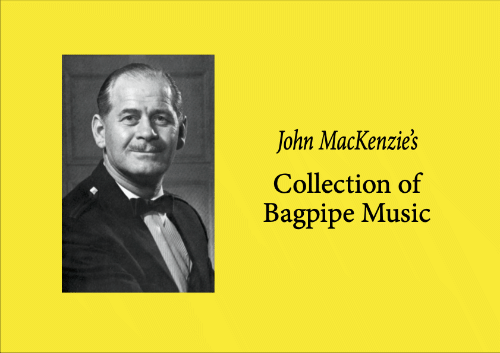
John MacKenzie’s Collection – digital book
First published in 1973, this outstanding collection is re-issued here in digital format with kind permission of the late Pipe Major’s family. The book runs to more than 50 pages. It is offered at a nominal price to cover overheads. It contains outstanding melodies such as the 6/8s Tug Argan Gap and MacNeills of Ugadale, the Wedding Waltz, Neuve Chappelle, Joe McGann’s Fiddle, the Saffron Kilt, He-Ro-Hirum and many others. Please note this is a digital download book set for tablet…